Payment by Invoice |
 How to find our store
 info@kurierbedarf.com
 Purchasing for Swiss customers
Topic: Threaded fittings for Airline Rails
Thread: M8
Materials: zinc-plated steel or V2A stainless steel
Versions: self-locking nut or star knob
Application: flexible mounting of suitable components and accessories to Airline Rails
Key selection criteria: clamping range, material, mounting method and intended application
Airline Rails are commonly associated with load securing, but their potential goes far beyond attaching lashing straps. With a suitable M8 threaded fitting for Airline Rails, the rail can also provide flexible mounting points for brackets, plates, modules and other suitable components.
Choosing the correct fitting is important. A short M8x25 fitting may be ideal for a thin bracket, while thicker assemblies require a larger clamping range. If a component needs to be removed frequently, a star knob can be more convenient than a self-locking nut. For installations exposed to moisture or weather, a V2A stainless steel fitting may be the preferred option.
This Kurierbedarf Technical Guide explains the differences between the available M8 threaded fittings and helps you select the right version for your Airline Rail installation.
Which threaded fitting do I need for my Airline Rail?
In short: Start with the total thickness of the component or assembly you want to mount. This determines the required clamping range. Then decide whether you need a self-locking nut for a longer-term installation or a star knob for quick, tool-free removal. Finally, choose between zinc-plated steel and V2A stainless steel according to the installation environment.
How does an M8 threaded Airline Rail fitting work?
A threaded fitting uses the hole pattern of a compatible Airline Rail to create a repositionable M8 threaded mounting point.
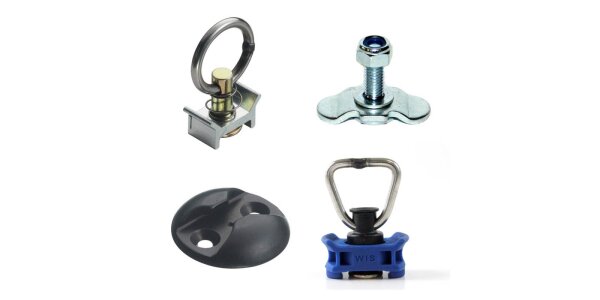
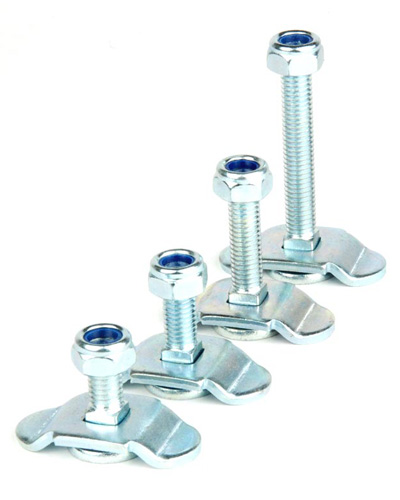
The fitting is inserted into the appropriate opening in the rail and positioned in the required location. The wing-shaped retaining plate locates the fitting in the rail system. A suitable component can then be placed over the M8 threaded stud and secured using the supplied self-locking nut or, depending on the version, a star knob.
The main advantage is flexibility. Unlike a permanently drilled mounting point, the fitting can be removed and repositioned at another suitable location along the Airline Rail when the layout of the installation changes.
Which M8 threaded Airline Rail fittings are available?
The Kurierbedarf range includes threaded fittings with different stud lengths, clamping ranges, materials and fastening options. This allows the mounting point to be selected according to the actual thickness and intended use of the component being installed.
Threaded fittings with self-locking nut
| Size | Clamping range | Material | Product |
|---|---|---|---|
| M8x25 | 0–7 mm | Zinc-plated steel | View M8x25 |
| M8x30 | 0–11 mm | Zinc-plated steel | View M8x30 |
| M8x40 | 0–22 mm | Zinc-plated steel | View M8x40 |
| M8x60 | 0–44 mm | Zinc-plated steel | View M8x60 |
| M8x25 | 0–7 mm | V2A stainless steel | View M8x25 V2A |
| M8x30 | 0–12 mm | V2A stainless steel | View M8x30 V2A |
| M8x40 | 0–22 mm | V2A stainless steel | View M8x40 V2A |
| M8x60 | 0–44 mm | V2A stainless steel | View M8x60 V2A |
Threaded fittings with star knob
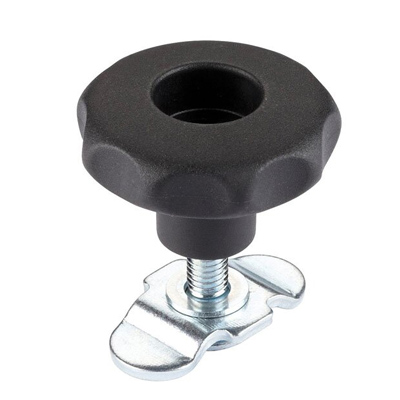
If components need to be installed, removed or repositioned regularly, an M8 threaded fitting with star knob provides a convenient alternative. The star knob can be operated by hand, making additional tools unnecessary for normal removal and repositioning.
| Version | Clamping range | Material | Product |
|---|---|---|---|
| M8x40 | 0–20 mm | Zinc-plated steel | View 0–20 mm |
| M8x60 | 0–40 mm | Zinc-plated steel | View 0–40 mm |
| M8x40 | 0–20 mm | V2A stainless steel | View 0–20 mm V2A |
| M8x60 | 0–40 mm | V2A stainless steel | View 0–40 mm V2A |
How do I choose the correct clamping range?
The clamping range is one of the most important specifications when selecting a threaded fitting. It determines the thickness of the assembly that can be secured with the respective version.
For fittings with a self-locking nut, the range extends from compact versions for thin components to long fittings for substantially thicker assemblies:
- 0–7 mm: suitable for very thin components, plates and brackets
- 0–11/12 mm: suitable for slightly thicker components, depending on the specific fitting version
- 0–22 mm: suitable for medium-thickness assemblies
- 0–44 mm: suitable for larger mounting thicknesses
The star knob versions cover clamping ranges of 0–20 mm and 0–40 mm.
Practical tip: Measure the complete assembly that will actually be clamped. Do not base your choice only on the thickness of one individual plate or bracket.
What do M8x25, M8x30, M8x40 and M8x60 mean?
The designation is straightforward. M8 identifies the nominal diameter of the metric thread. The second number identifies the respective length of the fitting or threaded stud.
A longer fitting generally allows a thicker assembly to be accommodated, but choosing the longest version is not automatically better. For practical selection, the specified clamping range is usually more important than the nominal stud length alone.
An unnecessarily long threaded stud may even be inconvenient where installation space is limited. The fitting should therefore be selected according to the actual mounting thickness.
Zinc-plated steel or V2A stainless steel?
There is no single material that is best for every application. The installation environment is the key factor.
| Feature | Zinc-plated steel | V2A stainless steel |
|---|---|---|
| Corrosion protection | Provided by the zinc-plated surface | High inherent corrosion resistance |
| Typical use | Vehicle interiors, workshop vans and general conversions | Interior and weather-exposed applications |
| Particularly useful for | General mounting applications | Camper vans, off-road vehicles and suitable exterior installations |
V2A stainless steel is particularly useful where fittings may regularly be exposed to moisture or weather. For exterior installations, however, the complete combination of materials should always be considered rather than evaluating the fitting alone.
When should I choose a self-locking nut?
A self-locking nut is a practical choice when a component is intended to remain installed for an extended period. Typical examples include brackets, modules or other suitable components that do not need to be removed regularly.
The locking function helps resist unintended loosening of the threaded connection. Correct installation is still essential, and the fastening must always be appropriate for the specific application.
When is a star knob the better option?
A star knob is particularly useful for modular installations. It allows a component to be released and secured by hand, making it convenient when equipment is frequently removed, repositioned or reconfigured.
This can be useful for removable vehicle modules, temporary mounting systems or accessories that are only installed when required.
Quick selection guide: which fitting should I choose?
| Requirement | Suggested version |
|---|---|
| Very thin assembly up to 7 mm | M8x25 |
| Assembly around 11–12 mm | M8x30 – check the exact product specification |
| Assembly up to 22 mm | M8x40 with nut |
| Assembly up to 44 mm | M8x60 with nut |
| Frequently removable, up to 20 mm | M8x40 with star knob |
| Frequently removable, up to 40 mm | M8x60 with star knob |
| Weather-exposed installation | Consider V2A stainless steel |
| General vehicle interior installation | Zinc-plated steel or V2A depending on requirements |
What can be mounted with an Airline Rail threaded fitting?
Threaded fittings are commonly used in commercial vehicle, camper van, trailer and service vehicle conversions. Depending on the design of the complete installation, they can be used to connect suitable brackets, plates, holders, modules and other components to an Airline Rail system.
V2A stainless steel versions can also be useful for suitable exterior installations, including certain camper van, roof or off-road applications where increased corrosion resistance is desirable.
The fact that a component can physically be attached to an M8 fitting does not automatically mean that the complete installation is suitable for the intended load. The entire mounting system must always be considered.
How strong is an M8 Airline Rail fitting?
The load capacity of a threaded fitting should never be assessed from the M8 thread size alone. Technical load ratings can differ between fitting versions, and the values specified for the individual product should always be observed.
More importantly, the rating of an individual fitting does not automatically represent the permissible load of the complete installation.
The overall capacity can also depend on:
- the type and specification of the Airline Rail
- how the rail is attached to the vehicle or supporting structure
- the strength and construction of the substrate
- the direction in which forces are applied
- the design of the mounted component
- the installation and additional fasteners used
Practical tip: Always evaluate the complete load path rather than looking at the fitting in isolation.
Do M8 fittings fit Airline Rails with 25 mm and 25.4 mm spacing?
The regular M8 threaded fittings in our range are designed for compatible Airline Rails with the commonly used 25 mm or 25.4 mm hole pattern.
However, always check the specification of the individual fitting and rail before installation. The hole pattern is an important compatibility factor, but the geometry and design of the complete rail system may also need to be considered.
5 common mistakes when choosing an Airline Rail threaded fitting
- Looking only at the M8 thread: Two M8 fittings can have very different stud lengths and clamping ranges.
- Automatically choosing the longest fitting: Extra length offers no benefit if the assembly is thin and installation space is limited.
- Measuring only one component: Measure the complete thickness that will actually be clamped.
- Choosing a nut for a frequently removable installation: A star knob may be much more convenient for modular equipment.
- Treating the fitting rating as the system rating: The Airline Rail, its installation and the supporting structure are all part of the complete mounting system.
Threaded fitting or ring fitting – which one do I need?
Both types can be used with Airline Rails, but they serve fundamentally different purposes.
A threaded fitting provides an M8 stud for attaching a suitable component directly to the rail system.
A ring fitting or Single-Stud fitting with ring provides an attachment point for suitable load securing equipment such as straps, hooks or other connecting elements.
The key question is therefore not which fitting is generally better, but what you actually want to attach to your Airline Rail.
Check the complete load path before installation
Before installation, inspect both the threaded fitting and the Airline Rail for visible damage or contamination. The fitting must be correctly and fully seated in the intended position in the rail.
For custom vehicle installations, it is useful to think about the complete path through which forces are transferred:
Mounted component → fastening element → threaded fitting → Airline Rail → rail installation → vehicle or supporting structure.
A reliable mounting solution depends on all of these components being suitable for the intended application.
Choosing the right M8 fitting starts with three questions
The range of available threaded fittings may look complicated at first, but the selection process can be reduced to three practical questions.
How thick is the assembly? This determines the required clamping range. Will the component remain installed or be removed regularly? This helps decide between a self-locking nut and a star knob. And where will the fitting be used? This influences the choice between zinc-plated steel and V2A stainless steel.
Once these three points are clear, selecting the appropriate M8 threaded fitting for your Airline Rail system becomes considerably easier.