Payment by Invoice |
 How to find our store
 info@kurierbedarf.com
 Purchasing for Swiss customers
Fittings, tie-down straps, cargo bars, threaded fittings and sliding nuts turn an Airline Rail into a versatile system for load restraint and equipment mounting. This guide explains which accessories are designed for which applications, how the different solutions compare and why hole spacing alone does not always determine compatibility.
An Airline Rail is essentially the foundation of a flexible mounting and load restraint system. It is the right combination of accessories that turns the rail into attachment points for tie-down straps, mounting points for suitable components or connection points for cargo bars and other specialist solutions.
The wide range of accessories is one of the system's greatest advantages – but it can also make choosing the right component confusing. Do I need a Single Stud or Double Stud fitting? When should I use a threaded fitting? What is the difference between a sliding nut and an Airline fitting? And does every accessory fit every Airline Rail?
This Kurierbedarf WIKI guide explains the most important types of Airline Rail accessories and helps you choose suitable solutions for vans, commercial vehicles, trucks, trailers, campers, motorhomes and custom vehicle conversions.
What accessories are available for Airline Rails?
Quick answer: The main types of Airline Rail accessories include Single Stud, Double Stud and Quattro Stud fittings for creating attachment points, tie-down straps with Airline end fittings for load restraint, cargo bars for positive-fit load securing, and threaded fittings or sliding nuts for mounting suitable components. Specialist fittings, hooks and adapters provide additional solutions for specific applications.
Airline Rail accessories at a glance
The easiest way to choose the right accessory is to start with the intended application. Not every component that fits into an Airline Rail performs the same function.
| Accessory | Function | Typical application |
|---|---|---|
| Single Stud Fitting | Creates an attachment point | Tie-down strap, carabiner or suitable connection |
| Double Stud Fitting | Attachment point engaging two rail positions | Load restraint and specialist mounting applications |
| Quattro Stud Fitting | Engages multiple rail positions | Special applications and custom constructions |
| Tie-down strap with Airline fitting | Restrains cargo | Direct connection between strap and rail |
| Cargo bar / load lock bar | Blocks cargo | Positive-fit load securing inside the cargo area |
| Threaded fitting | Creates a threaded mounting point | Brackets and suitable components |
| Sliding nut | Creates an individual threaded connection | Vehicle conversions and custom constructions |
| Specialist fitting | Provides a specific function | Hooks, adapters and specialist mounting solutions |
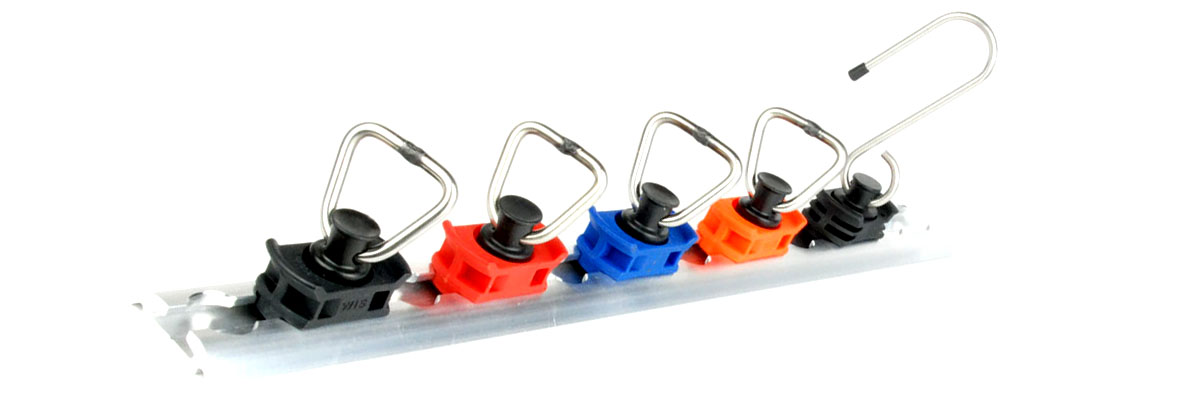
Single Stud, Double Stud and Quattro Stud fittings – what is the difference?
Conventional Airline fittings engage with the holes in an Airline Rail to create flexible attachment or mounting points.
Single Stud Fitting
A Single Stud Fitting engages at one position in the Airline Rail. Its compact design makes it quick to install and easy to reposition when transport requirements change.
Depending on the design, Single Stud fittings may feature a ring, eye or another connection point for attaching suitable equipment.
Double Stud Fitting
A Double Stud Fitting engages with two adjacent positions in the Airline Rail. Its design therefore differs significantly from a Single Stud fitting.
Double Stud fittings are available in different versions for different applications. The permitted load always depends on the technical specifications of the individual fitting.
Quattro Stud Fitting
Quattro Stud Fittings engage across multiple positions in the rail and are designed for specialist applications. The number of engagement points alone, however, should not be used to determine the permitted load capacity.
Single, Double and Quattro primarily describe the design of the fitting and the number of rail positions it engages with. When choosing a fitting, its specified load rating, load direction, manufacturer information and the Airline Rail being used must also be considered.
Ring fitting or tie-down strap with a permanently attached Airline fitting?
There are different ways to connect a tie-down strap to an Airline Rail. A separate ring or eye fitting first creates a flexible attachment point in the rail. A suitable tie-down strap or other approved connection can then be attached to it.
With a tie-down strap featuring a permanently attached Airline fitting, the end fitting is already part of the strap. The strap can therefore be connected directly to a compatible Airline Rail.
Which option is more practical depends on the application. Separate fittings allow different components to be combined flexibly, while permanently attached Airline end fittings reduce the number of individual parts and provide a particularly direct connection to the rail.
Threaded fittings – turning an Airline Rail into a mounting system
A threaded fitting serves a different purpose from a conventional ring fitting. Instead of providing an attachment point for a tie-down strap, it creates a threaded connection within the Airline Rail.
Depending on the fitting design, thread size and intended construction, suitable brackets or components can then be positioned flexibly along the rail.
Threaded fittings are therefore particularly useful for van conversions, campers, motorhomes, service vehicles and custom mounting solutions.
For more detailed information, our WIKI explains how to select and use threaded fittings for Airline Rails.
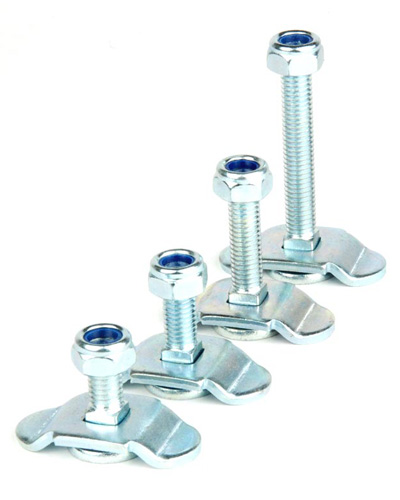
Sliding nuts for custom constructions
Sliding nuts extend the possibilities of an Airline Rail system even further. Depending on their design, they may feature internal or external threads and can provide flexibly positioned mounting points for custom constructions.
Typical applications include brackets, vehicle conversion components and other suitable equipment mounted inside a vehicle.
Again, thread size is not the only factor to consider. The design of the sliding nut must be compatible with the Airline Rail and suitable for the intended application.
Cargo bars and load lock bars – blocking cargo instead of only lashing it
In addition to securing cargo with tie-down straps, Airline Rails can also be used for positive-fit load securing.
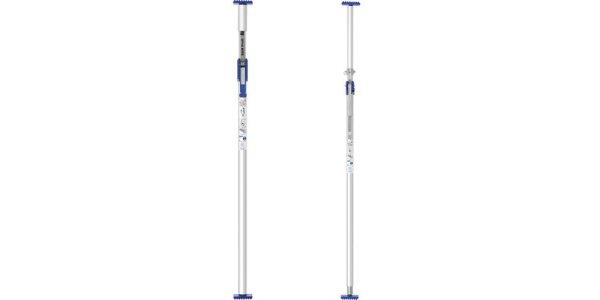
This is where cargo bars and load lock bars can be used. They are positioned between appropriately arranged rails and can divide the cargo area or help prevent loads from shifting during transport.
The correct cargo bar depends on factors such as the distance between the rails, the connection system, the adjustment range and the technical specifications of the individual product.

Specialist fittings – Airline Rails can do more than restrain cargo
The range of Airline Rail accessories extends far beyond conventional lashing points. Depending on the application, there are hooks, adapters, specialist end fittings and other mounting components.
One example is the Butler fitting. Instead of providing a conventional lashing point, it features a hook that can be used to hang suitable items such as tools, brooms or clothing.
Other specialist solutions can provide multiple threaded mounting points, special connections or individual mounting options within an existing Airline Rail system.
Does every Airline Rail accessory fit every Airline Rail?
No – and this is one of the most common causes of ordering the wrong accessory.
Many Airline Rails use a hole spacing of 25 or 25.4 mm. However, this does not automatically mean that every accessory will fit every rail profile.
Depending on the accessory, additional factors may include:
- Airline Rail profile geometry
- internal dimensions and available installation depth
- rail material thickness and design
- design of the fitting or sliding nut
- locking mechanism
- intended application
This is particularly important with threaded fittings, sliding nuts and specialist fittings, where checking the individual product specifications before ordering can prevent compatibility problems.
Do not check the hole spacing alone. When buying accessories for an existing Airline Rail, also check the rail profile and the compatibility information provided for the accessory. Two rails with the same hole spacing can still differ in their internal geometry.
What determines the load capacity of Airline Rail accessories?
A common question is: How much load can an Airline fitting take? A single general figure would be misleading.
For a safe mounting or load restraint solution, several components must be considered together:
- Airline Rail and its technical specifications
- how the rail is attached to the supporting structure
- fitting or attachment being used
- tie-down equipment or other connecting components
- direction of load
- specific installation and intended application
The load rating of one individual component therefore cannot automatically be applied to the complete installation. Always follow the technical specifications and requirements of all components being used.
5 common mistakes when choosing Airline Rail accessories
- Checking only the hole spacing: A 25 or 25.4 mm spacing alone does not guarantee compatibility with every accessory.
- Choosing a fitting only by the number of engagement points: Single, Double or Quattro alone does not determine whether a fitting is suitable for a specific load.
- Confusing ring fittings with threaded fittings: A ring fitting provides an attachment point, while a threaded fitting provides a threaded connection.
- Looking only at the load rating of one component: Rail, installation, fitting and other components work together as a complete system.
- Considering the application only after purchasing: First decide whether you need to restrain cargo, block a load or mount a component.
Which Airline Rail accessory do I need for my application?
Choosing the right accessory becomes much easier when you start with the task rather than the product:
| I want to … | Typical solution |
|---|---|
| create a flexible attachment point | Single Stud or Double Stud Fitting |
| connect a tie-down strap directly to the rail | Tie-down strap with Airline end fitting |
| block cargo inside the load area | Cargo bar or load lock bar |
| bolt a suitable component to the rail | Threaded fitting or sliding nut |
| organise tools or equipment | Hook or specialist fitting |
| build a custom mounting solution | Sliding nut, adapter or specialist fitting |
Understanding Airline Rail accessories as a flexible system
The main advantage of an Airline Rail is not any single fitting. It is the ability to use different accessories flexibly within one adaptable rail system.
Today you may need an attachment point for a tie-down strap, tomorrow a cargo bar, and during a vehicle conversion perhaps a removable threaded mounting point. This versatility is what makes Airline Rails useful in vans, commercial vehicles, trucks, trailers, campers and motorhomes.
The key is not to choose accessories based solely on appearance or hole spacing. Application, rail profile, fitting design and technical load ratings must work together. Taking all of these factors into account allows you to make much better use of the flexibility an Airline Rail system can provide.