Payment by Invoice |
 How to find our store
 info@kurierbedarf.com
 Purchasing for Swiss customers
Quick overview: Clamping bars are telescopic load-securing devices for vans, trucks, trailers and box bodies. Conventional versions are tensioned between suitable surfaces inside the load area and do not require permanently installed lashing rails.
In this guide: function · designs · working lengths · blocking capacity · horizontal & vertical use · clamping bar vs. shoring bar · common mistakes · selection guide
Clamping bars – also referred to as load lock bars or clamping beams – are a flexible way to divide load areas and help prevent suitable cargo from shifting inside vans, trucks and trailers.
Unlike many shoring bars, conventional clamping bars do not require permanently installed lashing rails. They are tensioned between suitable surfaces inside the cargo area, can be released again and repositioned when transport requirements change.
However, choosing the right clamping bar involves more than simply selecting a suitable length. Working length, tensioning mechanism, tube diameter, contact surfaces and technical load values all play an important role. This guide explains what to consider when selecting and using a clamping bar.
What is a clamping bar and how does it work?
Quick answer: A clamping bar is a telescopic load-securing device that is tensioned between two suitable surfaces inside the cargo area. Rubberised or non-slip end pads support the bar against the contact surfaces. This allows the bar to divide loading areas and help block suitable cargo against movement.
To use the bar, it is first adjusted to the required length. Depending on the design, tension is then applied using a rack-and-lever mechanism or another tensioning system.
The main practical advantage is flexibility. If the load layout changes on the next journey, the clamping bar can be released and installed at another suitable position.
What types of clamping bars are available?
Clamping bars can differ significantly in their construction. In our range, two systems are particularly relevant: conventional clamping bars with rack and tensioning lever and the SAM 55 Professional with internal webbing strap and telescopic brake.
| Design | Tensioning principle | Typical use |
|---|---|---|
| Rack & tensioning lever | Telescopic length adjustment and mechanical tensioning | Vans, trucks, box bodies and trailers |
| SAM 55 with webbing mechanism | Internal webbing strap with telescopic brake | Vans, refrigerated vehicles and more sensitive interior surfaces |
Clamping bars with rack and tensioning lever
With the conventional design, the clamping bar is first telescopically adjusted to the required length. It is then tensioned using a rack and tensioning lever.
This construction is robust, straightforward to use and well suited to changing transport tasks. Our conventional aluminium clamping bars use a 42 mm tube diameter and feature large rubber feet at the ends.
Depending on the version, working lengths from 1.05 to 2.70 m are available. This allows both compact vans and wide truck or box-body applications to be covered.
You can find the available versions in our Clamping Bars & Load Lock Bars category.
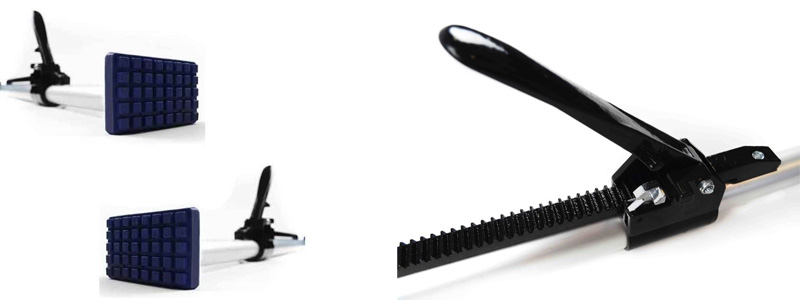
SAM 55 Professional – clamping bar with internal webbing strap
The SAM 55 Professional clamping bar uses a different system. Instead of a conventional rack mechanism, it works with an internal webbing strap and telescopic brake.
The aluminium tube has a diameter of 55 mm. The clamping bar is available in three working ranges:
- 1.65–2.10 m
- 1.85–2.30 m
- 2.10–2.55 m
The tensioning system allows more controlled tensioning. This can be particularly useful in vans, refrigerated vehicles or cargo areas with more sensitive interior surfaces.

Which clamping bar length do I need?
The working length or adjustment range is one of the most important selection criteria. The relevant measurement is not the maximum interior width of the vehicle, but the actual distance at the exact position where the clamping bar will be installed.
In vans, this distance can vary considerably depending on installation height. Wheel arches, interior panels, shelving systems and other vehicle conversions can further reduce the usable width.
| Version | Working lengths / adjustment ranges |
|---|---|
| Clamping bar for vans | 1.05–1.40 m · 1.10–1.47 m · 1.20–1.57 m · 1.30–1.67 m · 1.40–1.77 m · 1.50–1.87 m · 1.60–1.97 m · 1.70–2.07 m · 1.80–2.17 m · 1.90–2.27 m |
| Clamping bar for trucks & box bodies | 2.00–2.37 m · 2.10–2.47 m · 2.20–2.57 m · 2.26–2.60 m · 2.36–2.70 m |
| SAM 55 Professional | 1.65–2.10 m · 1.85–2.30 m · 2.10–2.55 m |
Measure directly at the intended installation position and, if possible, at the exact height at which the clamping bar will be used. The interior width of a van can differ significantly near the floor, halfway up the side wall and close to the roof.
Can clamping bars be used horizontally and vertically?
The most common application is horizontal installation between the side walls of the load area. This can divide cargo spaces or help limit movement of suitable packages and loads.
Depending on the clamping bar, vehicle structure and installation situation, vertical installation between the floor and a suitable upper surface may also be possible.
In both cases, it is not enough that the bar physically fits between the two surfaces. The contact areas must also be capable of handling the forces created during tensioning.
Not every interior panel, side wall or roof lining in a van is suitable as a tensioning surface. Thin panels can deform or become damaged. Always check the actual vehicle structure before use.
What does the blocking capacity of a clamping bar mean?
The blocking capacity is an important technical value. However, it does not simply represent the cargo weight that can always be secured with the clamping bar regardless of installation conditions.
For our conventional aluminium clamping bars with a 42 mm tube diameter, the specified blocking capacity is 140 daN.
Practical performance is also influenced by several factors:
- condition and strength of the contact surfaces
- condition of the rubber feet or end pads
- moisture, dust or contamination
- installation position and tensioning
- vehicle and cargo-area construction
A specified blocking capacity should therefore not be converted directly into a universally permissible cargo weight. Load securing must always be considered as a complete system involving the cargo, vehicle, installation situation and securing equipment used.
Why more tension does not automatically mean more safety
A common mistake is to tension a clamping bar as tightly as possible between the vehicle walls. More pre-tension, however, does not automatically result in better load securing.
Excessive tension can place unnecessary stress on sensitive side walls or interior panels and may even cause damage. At the same time, increasing the tension does not turn a clamping bar into an infinitely load-bearing securing device.
The bar should therefore be used according to its design and the relevant technical instructions.
Clamping bar or shoring bar – what is the difference?
Both systems can be used to divide cargo areas and help prevent cargo from shifting. The main technical difference is how they are attached.
A clamping bar is tensioned between suitable surfaces. Conventional versions do not require permanently installed lashing rails.
A shoring bar, on the other hand, is inserted into suitable lashing rails or sockets, creating a defined mechanical connection with the existing rail system.
| Feature | Clamping bar | Shoring bar |
|---|---|---|
| Attachment | Tensioned between suitable surfaces | Inserted into lashing rails or sockets |
| Lashing rail required? | No | Usually yes |
| Positioning | Highly flexible | Depends on the rail system |
| Typical advantage | Quick repositioning without lashing rails | Defined mechanical connection to the rail system |
Which solution is more suitable therefore depends heavily on the vehicle and intended application. If a compatible lashing rail system is already installed, a shoring bar may be a good option. If maximum flexibility and quick repositioning are more important, a clamping bar can be the better choice.
Which vehicles are clamping bars suitable for?
Clamping bars are used in a wide range of vehicles and body types, including:
- vans and panel vans
- compact commercial vehicles
- trucks with box bodies
- trailers
- courier vehicles
- service and workshop vans
- refrigerated and freezer vehicles
The vehicle model alone does not determine the correct length. Even two identical vans can have different usable widths depending on interior lining, shelving systems and custom conversion work.
For clamping bars, the rule is therefore simple: choose the working length according to the actual installation situation, not just the vehicle model.
Which clamping bar suits which application?
The following table provides a quick first guide. The actual installation width and suitability of the contact surfaces remain the deciding factors.
| Application | Possible solution |
|---|---|
| Compact vans and smaller load areas | Clamping bars with working lengths from 1.05 m |
| Large vans and truck box bodies | Clamping bars with working lengths up to 2.70 m |
| More sensitive cargo-area walls | Consider the SAM 55 with internal webbing mechanism |
| Vehicle with suitable lashing rails | Depending on the application, also consider a shoring bar |
| Unusual installation width or custom body | Measure carefully and check whether a special solution is required |
5 common mistakes when using clamping bars
- Ordering the wrong working length: Do not rely on the vehicle width from a technical data sheet. Measure directly at the intended installation position.
- Using unsuitable contact surfaces: Thin or sensitive interior panels can be damaged by tensioning forces.
- Over-tightening the clamping bar: More pre-tension does not automatically mean more safety.
- Ignoring wet or dirty contact surfaces: They can reduce the grip of the rubber feet or end pads.
- Equating blocking capacity with cargo weight: Load securing must always be considered as a complete system.
FAQ – common questions about clamping bars
What is the difference between a clamping bar and a load lock bar?
The terms clamping bar and load lock bar are often used for the same general product group. They usually refer to telescopic load-securing devices that are tensioned between suitable surfaces inside a cargo area.
How do I choose the correct clamping bar length?
Measure the distance exactly at the intended installation position. The measured value must fall within the adjustment range of the chosen clamping bar. In vans, the usable interior width can vary significantly depending on installation height and interior conversion.
Does a clamping bar require a lashing rail?
No. Conventional clamping bars are tensioned between suitable surfaces and do not require a permanently installed lashing rail. Shoring bars are normally inserted into suitable rails or sockets.
Can a clamping bar be used horizontally and vertically?
Depending on the model, vehicle and installation situation, a clamping bar can be used horizontally or vertically. The intended contact surfaces must be suitable for the forces created during tensioning.
What does 140 daN blocking capacity mean?
140 daN is the specified blocking capacity of our conventional aluminium clamping bars with a 42 mm tube diameter. This value should not be converted directly into a universally permissible cargo weight because installation conditions, contact surfaces and vehicle construction must also be considered.
Which is better – a clamping bar or a shoring bar?
That depends on the application. A clamping bar can be tensioned flexibly between suitable surfaces and does not require a lashing rail. A shoring bar is inserted into a compatible rail system and therefore creates a defined mechanical connection with that system.
Can I use a clamping bar in any van?
The vehicle model alone does not determine suitability. The adjustment range must match the actual installation width, and the intended contact surfaces must be suitable for tensioning.
The right clamping bar starts with the right measurement
When selecting a clamping bar, the vehicle model is only a starting point. What really matters is the actual installation width, suitable contact surfaces, intended position and transport application.
Our main recommendation is therefore simple: measure first, then choose the adjustment range. After that, you can decide whether a conventional rack-and-lever clamping bar, a SAM 55 with internal webbing mechanism or – where suitable lashing rails are already installed – a shoring bar is the better solution.
Our clamping bars and load lock bars cover working ranges from 1.05 to 2.70 m. If you are unsure about the correct length, design or installation situation, we will be happy to help you choose a suitable version.