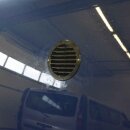
The wind-powered roof fan for vans is an ideal solution for vehicles with larger cargo areas when heat, fumes, and odors need to be efficiently removed—without any power connection. Especially with heavy loads, warm outside temperatures, or long downtimes, it reliably ensures natural air circulation.
Roof fan for vans – wind-powered
This high-quality roof fan uses only the airflow to generate powerful suction. This makes it particularly maintenance-free, durable, and ideal for vehicles that need to be ventilated independently of electrical systems. Its low installation height makes it suitable for use on almost all van roofs.
- Extremely powerful extraction – almost twice as effective as standard models
- Ideal for large vans, refrigerated vehicles, and mobile workshops
- Completely power-free – no electrical system, no sources of error
- Maintenance-free & resistant to weather and UV radiation
- Effectively reduces heat, condensation, and odors
- Also adapts to curved roof contours
What problems does the roof fan solve?
In many vans, an unpleasant or even hazardous interior climate develops when driving or working while stationary. The wind-powered roof fan effectively prevents the following typical problems:
-
Heat build-up in summer or when machines are running
-
Condensation due to damp cargo or temperature differences
-
Stagnant air in the cargo area when the doors are closed
-
Odors from goods, waste, or workshop equipment
-
Vapor and gas accumulation in transport areas requiring ventilation
Wind-driven vs. electric – which roof fan is better?
Whether a wind-driven or electric roof fan makes more sense depends on the area of application. The following comparison makes the choice easier:
-
Wind-driven fan: no electricity, very high extraction power while driving, maintenance-free, ideal for vehicles that are mainly on the move.
-
Electric fan: constant performance even when stationary, requires power supply, frequent maintenance required, ideal for service vehicles or stationary operation.
For transporters that spend a lot of time on the road, the wind-powered roof fan is usually the most efficient and reliable choice.
Technical data
Technical data of the wind-powered roof fan
| Feature |
Value |
| Color |
Black or white |
| Hole size |
96 mm |
| Installation height above roof |
113 mm |
| Installation height below roof |
49 mm |
| Diameter above roof |
240 mm |
| Diameter below roof |
170 |
| Roof thickness |
1–17 mm |
| Material |
ABS plastic |
Conclusion
The wind-powered roof fan for vans is a durable, completely maintenance-free, and extremely efficient solution for natural ventilation. Especially in large cargo areas, it offers maximum performance without an electrical connection and permanently improves the working and transport climate.
FAQs about wind-powered roof fans
How much air does a wind-powered roof fan move?
The fan generates a very high extraction capacity thanks to the airflow – up to twice as much as many conventional models. The faster the vehicle travels, the higher the air circulation.
Does the roof fan require an electrical supply?
No, the fan operates exclusively on airflow. It is completely power-free, requires no wiring, and is therefore virtually maintenance-free.
Can the roof fan also ventilate when stationary?
Basic ventilation is always available, but the maximum extraction power is only available while driving. An additional electric fan is recommended for ventilation when stationary.
Is it necessary to register the fan in the vehicle documents?
Thanks to its low installation height, the roof fan does not usually require registration. Only models with an installation height of more than 50 mm must be registered for vehicles under 2 m.
For which vehicle types is the roof fan suitable?
The fan is suitable for transporters, panel vans, refrigerated vehicles, workshop vehicles, campers, off-road vehicles, and all transporters with a large interior volume.
 Payment by Invoice |
 How to find our store
 info@kurierbedarf.com
 Purchasing for Swiss customers