Payment by Invoice |
 How to find our store
 info@kurierbedarf.com
 Purchasing for Swiss customers
Safe load securing is essential in transportation. Whether in commercial use, trade or private transportation - inadequately secured loads represent a considerable safety risk. Lashing straps are one of the most important tools for reliably securing loads in vans or trailers and complying with legal requirements.
In this article, you will find out how lashing straps are constructed, which standards apply, what to look out for when selecting them and why properties such as length, pre-tensioning force or material play a decisive role.
What are lashing straps and what are they used for?
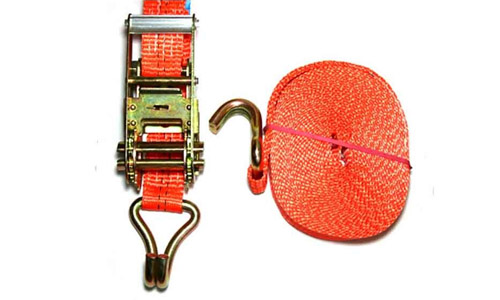
Lashing straps – often also referred to as tension belts – are textile securing devices that are used to secure loads in road traffic. They usually consist of a polyester (PES) webbing, a ratchet or a buckle and end fittings such as hooks.
Typical areas of application are:
- Load securing in vans
- Fixing pallets and machines
- Securing building materials, furniture or tools
- Transports with car trailers
Lashing straps ensure that the load does not shift, tip over or become damaged during the journey, thereby protecting both the driver and other road users.
Legal principles and standards
There are clear legal and normative requirements for lashing straps in road traffic. The relevant standard is DIN EN 12195-2. This standard specifies the requirements that lashing straps must meet in terms of material, marking, load capacity and safety.
A standard-compliant lashing strap has:
- A permanently attached label
- Information on LC, STF and SHF
- Material identification (e.g. PES)
- Manufacturer and standard information
If the label is missing or no longer legible, the lashing strap may no longer be used - regardless of the visual condition of the webbing.
Structure of a lashing strap
A classic two-part lashing strap consists of several components, each of which is relevant to safety:
Belt webbing made from polyester (PES)
Polyester (PES) is used almost exclusively for load securing in road transport. This material is characterized by low elongation, high abrasion resistance and weather resistance.
A typical feature of PES webbing is the blue label, which indicates the suitability of the material.
Ratchet and tensioning mechanism
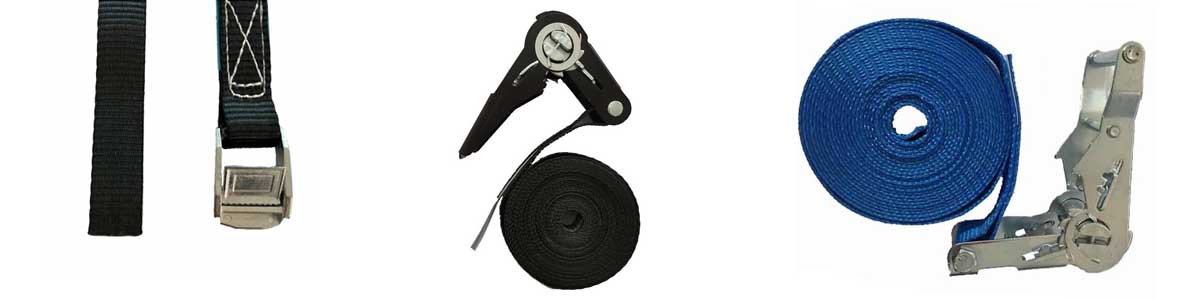
The ratchet is used to tension the webbing and build up the required pre-tensioning force. High-quality lashing straps have industrial pressure ratchets, which function reliably even with frequent use.
Important parameters in this context are:
- STF (Standard Tension Force) – pre-tensioning force
- SHF (Standard Hand Force) – defined hand force (50 daN)
End fittings and hooks
Depending on the application, different hooks are used as end fittings. Double-pointed hooks are often used, which are suitable for classic lashing in vans and trailers.
It is important that the lashing is correctly positioned in the hook base to ensure even force transmission.
LC, STF and SHF – what do these values mean?
The characteristic values stated on the label are decisive for the correct use of a lashing strap.
LC (Lashing Capacity) refers to the maximum permissible load of the lashing strap including ratchet and end fittings. This value is given in decanewtons (daN).
STF (Standard Tension Force) indicates the pre-tensioning force that the ratchet can build up with a defined manual force.
SHF (Standard Hand Force) is the standardized hand force of 50 daN with which the ratchet is operated.
These values must not be equated with the weight of the load, but are used to calculate safe load securing.
Why the right length is crucial
Lashing straps are available in different lengths - common variants are 4 meters or 6 meters. Choosing the right length depends on several factors:
- Size and shape of the load
- Distance between the lashing points
- Type of securing (strapping or direct pull)
Shorter straps are suitable for compact loads, while longer lashing straps offer more flexibility for bulky goods or large loading areas.
Lashing straps as a set – useful for regular use
In many applications, several lashing straps are required at the same time. Lashing strap sets with identical lengths and designs make handling easier and ensure uniform safety standards.
Advantages of sets:
- Equal load capacity of all straps
- uniform handling
- practical for vehicle fleets and workshops
- flexible securing of multiple charging points
Each lashing strap in the set is tested individually and sorted out separately in the event of damage
.
Worn-out and regular testing
Lashing straps do not have a fixed expiry date. Nevertheless, there are clear criteria as to when they may no longer be used.
Typical reasons for the expiry date are:
- Yarn breakage or heavy wear and tear
- Cuts of more than 10% of the belt width
- Damaged seams
- deformed or corroded ratchets
- expanded or damaged hooks
- missing or illegible label
Regular visual inspection before use is therefore essential.
Care and storage of lashing straps
The service life of lashing straps can be significantly extended with proper care. After use, straps should be cleaned and stored in a dry place
It is recommended that the ratchet is lightly rinsed regularly to avoid corrosion and malfunctions, especially if it is used frequently outdoors.
Conclusion: lashing straps as an indispensable securing device
Lashing straps are a central element of load securing in road transport. Their safe use requires that they are designed in accordance with standards, correctly dimensioned and regularly tested.
Whoever pays attention to high-quality materials, clear labeling and suitable lengths creates the basis for safe transport - regardless of whether individual belts or complete sets are used.