Payment by Invoice |
 How to find our store
 info@kurierbedarf.com
 Purchasing for Swiss customers
Whether for tradespeople, delivery services, mobile workshops, shuttle vehicles or camper conversions – anyone working daily with a van gets in and out of the vehicle far more often than most people realize. Especially on larger vans such as the Mercedes Sprinter, VW Crafter, Ford Transit, Opel Movano, Fiat Ducato, Renault Master or Renault Trafic, the entry height is noticeably higher than on a regular passenger car. A rigid side step for vans can therefore make a significant difference in everyday use.
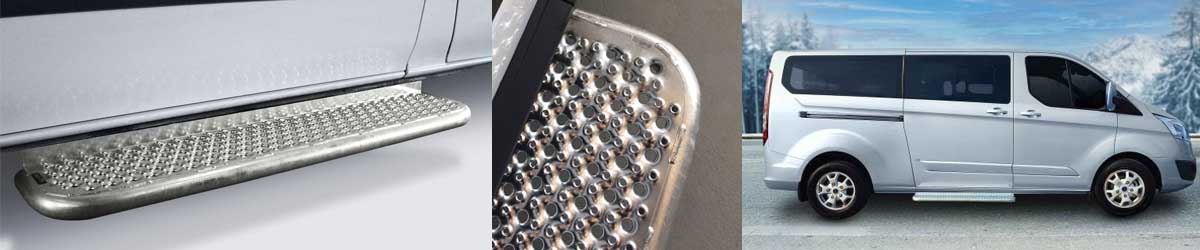
It improves access through the sliding door, increases safety in rain, snow or dirt, and reduces daily physical strain. A rigid ST side step is especially interesting for vehicles where a durable, maintenance-free and permanently available solution is required. Unlike electric or mechanically automatic systems, it remains permanently mounted to the vehicle and is always ready for use.
Which side step is best for commercial vans?
For many commercial vans, a rigid side step is one of the most practical solutions when durability, simplicity and low maintenance are the priorities. It is permanently mounted, requires no operation, no electrical components and no moving parts. This makes it especially suitable for tradespeople, delivery fleets, service vehicles, shuttle vans and vehicles with frequent daily use.
What is a rigid side step?
A rigid side step is a permanently mounted entry step for the sliding door or side access area of a van. It stays fixed in position and is immediately available whenever the side door is used.
The main advantage lies in its simple and robust construction. Since no electric motors, sensors or moving hinges are required, the side step is highly resistant to dirt, moisture and intensive use. Many ST-series models feature a 220 mm step depth, a non-slip stepping surface and a load capacity of up to 150 kg.
At the same time, the overall vehicle width increase remains relatively small. On many versions it is only around 120 mm. This keeps the vehicle practical for everyday use while making entry significantly more comfortable.
Which vans are compatible with rigid side steps?
Rigid side steps are available for a wide range of popular vans and transporters. They are especially common on large panel vans, minibuses and commercial vehicles used every day in professional environments.
| Vehicle Model | Typical Applications | Special Notes |
|---|---|---|
| Mercedes Sprinter | Trades, transport, service, shuttle | Different versions for FWD, RWD and AWD |
| VW Crafter / MAN TGE | Fleet vehicles, delivery services, camper builds | Some versions only fit on passenger side |
| Ford Transit / E-Transit | Commercial use, parcel delivery, EV fleets | Available for FWD, RWD and electric models |
| Ford Transit Custom / VW T7 Transporter | Service vehicles, trades, mobile teams | Compact vans with frequent sliding door access |
| Fiat Ducato / Jumper / Boxer | Trades, delivery services, camper vans | Available for many wheelbases and roof heights |
| Renault Master IV / Opel Movano C | Transport, service, fleet operation | Also suitable for modern electric variants |
| Renault Trafic / Nissan Primastar / NV300 | Service, shuttle, compact transport tasks | Compatible with short and long wheelbase models |
| Mercedes Vito / V-Class / eVito / EQV | Shuttle, passenger transport, service | Ideal for vans and minibuses |
Why are rigid side steps so practical for daily commercial use?
In everyday work, an entry step above all needs to be reliable. This is exactly where a rigid side step has its biggest advantage. It is always there, always ready and does not need to be extended or activated. That is especially useful for vehicles making many stops throughout the day.
Delivery drivers, mobile workshops and service technicians often enter and exit the vehicle dozens of times per day. A stable side step not only improves comfort, but also increases safety.
The non-slip surface becomes particularly important in poor weather conditions. Wet shoes, snow, mud or dust can make entering the van more dangerous. A sturdy side step provides additional support and helps reduce the risk of slipping.
Rigid side step or mechanically automatic side step?
Besides rigid side steps, there are also mechanically automatic systems that extend and retract together with the door movement. While these can offer additional comfort, they are mechanically more complex. The best choice depends on how the vehicle is used.
| Feature | Rigid Side Step | Mechanically Automatic Side Step |
|---|---|---|
| Operation | Permanently fixed and always visible | Extends automatically with door movement |
| User Control | No operation required | Automatic via door mechanism |
| Maintenance | Very low to maintenance-free | Contains moving mechanical components |
| Durability | Very high due to simple construction | Comfort-oriented but more complex |
| Availability | Always ready for use | Depends on mechanism and door position |
| Best suited for | Commercial heavy-duty use | Comfort-focused applications |
For intensive commercial use, the rigid version is often the more practical choice. It is simpler, more robust and requires less maintenance. Mechanically automatic side steps can be useful where appearance and comfort are more important.
What about approvals, certification and vehicle registration?
Vehicle approval is an important topic when installing side steps. Depending on the version and vehicle model, a side step may come with an ABE, a technical report or require an individual inspection.
A side step with ABE is usually the easiest option, since no additional inspection may be required. Versions supplied with a technical report normally need to be registered in the vehicle documents. If no approval documents are included, an individual inspection by an authorized engineer is generally required.
Before purchasing, it is therefore important to verify the exact vehicle configuration and approval status of the selected side step. This is especially relevant for similar vehicles with different drivetrains, wheelbases or model years.
Why vehicle specifications are important before purchasing
Many vans may look similar but differ significantly from a technical perspective. For example, a Mercedes Sprinter with front-wheel drive is not automatically compatible with a side step designed for rear-wheel drive or AWD versions. The same applies to vehicles such as the Ford Transit, VW Crafter, MAN TGE or Opel Movano.
Wheelbase, drivetrain, sliding door position and optional equipment all play an important role. On some vehicles, components such as fuel tanks or air-conditioning lines can affect installation on one side of the vehicle.
Main advantages of the ST-series side steps
The ST-series has been developed specifically for professional use. It combines a durable construction, non-slip stepping surface and easy everyday usability without additional operation.
- Robust construction for daily use
- Maintenance-free design without moving parts
- Non-slip surface for improved safety
- 220 mm step depth for comfortable access
- High load capacity up to 150 kg
- Available with ABE, technical report or individual approval depending on model
- Suitable for many vans, minibuses and transporters
- Ideal for trades, service fleets, delivery vans and shuttle vehicles
Who benefits most from a rigid side step?
A rigid side step is especially useful for users who rely on their vehicle every day. This includes tradespeople, mobile service teams, parcel delivery services, couriers, municipal fleets, camper builders and shuttle operators.
In commercial environments, functionality usually comes first: safe entry, fast workflow, minimal maintenance and maximum durability. This is exactly what makes a rigid side step such a practical solution.
Conclusion: Rigid side steps are practical everyday solutions for vans
A rigid side step for vans is far more than just an accessory. It improves vehicle access, increases safety during entry and exit, and reduces physical strain during frequent daily use.
Especially for commercial vehicles, the simple construction is a major advantage. No electrical system, no sensors and no moving mechanisms – just a permanently available, stable and non-slip stepping surface. Whether for a Mercedes Sprinter, VW Crafter, Ford Transit, Opel Movano, Renault Master, Fiat Ducato, Renault Trafic, Nissan Primastar or Mercedes Vito, there are suitable ST-series side steps available for many vehicle types.
Anyone working with their van on a daily basis benefits from improved comfort, better ergonomics and safer vehicle access. The most important thing is to verify the correct vehicle configuration, wheelbase, drivetrain and approval requirements before purchasing.
❓ Frequently Asked Questions About Rigid Side Steps for Vans
What is a rigid side step?
A rigid side step is a permanently mounted entry step for vans. It remains fixed in position, requires no operation and improves access through the side sliding door.
What are the advantages of a rigid side step compared to a mechanically automatic version?
A rigid side step has a simpler design, is always available and is especially durable. Mechanically automatic side steps provide more comfort but contain additional moving components.
Which vehicles are compatible with ST-series rigid side steps?
ST-series rigid side steps are available for vehicles such as the Mercedes Sprinter, VW Crafter, MAN TGE, Ford Transit, Ford Transit Custom, Renault Master, Opel Movano, Fiat Ducato, Citroën Jumper, Peugeot Boxer, Renault Trafic, Nissan Primastar, Mercedes Vito and many more.
Does a rigid side step need to be registered?
That depends on the version. Some side steps are supplied with ABE approval, others with a technical report or without approval documents. Versions without approval usually require an individual inspection.
How much weight can a rigid side step support?
Many ST-series side steps are designed for a load capacity of up to 150 kg. Always check the technical specifications of the individual product.
Are rigid side steps maintenance-free?
Yes. Since rigid side steps do not contain electrical systems or moving components, they are generally maintenance-free and highly reliable for everyday use.