 Payment by Invoice |
 How to find our store
 info@kurierbedarf.com
 Purchasing for Swiss customers
Reliable load securing is a must in road transport - and at the same time ensures maximum safety for your goods and all road users. Anyone who regularly transports bulk goods, pallets or bulky goods knows the problem: even short journeys can lead to dangerous load movements if the securing is not properly planned. In addition to lashing straps, nets or anti-slip mats, locking beams and locking bars are among the most important everyday aids. They can be used quickly, are versatile and offer excellent value for money. Whether in vans, trucks, containers, trailers or box bodies - with the right locking bars, loads can be secured securely without placing unnecessary strain on the load.
Locking beams & locking bars: Why form-fitting securing is so effective
In essence, load securing is based on two principles: force-locking (e.g. lashing straps that lash down) and form-fit (e.g. locking beams that block the load). Locking beams and locking bars work via positive locking: they are clamped between two stable counter bearings - such as side walls, airline rails or perforated rails - and thus prevent the transported goods from moving.
The advantage is obvious: instead of forcing the load downwards or running belts over sensitive surfaces, the available space in the cargo area is used cleverly. Pallets, crates or machines are wedged in such a way that they cannot slip or tip over during braking, evasive maneuvers or cornering. This is not only safe, but also much more gentle on the material.

How locking beams work – briefly explained
Locking beams and locking bars can be inserted in seconds. Depending on the system, they are installed horizontally or vertically. Horizontally, they are usually used as a barrier behind pallets or goods, vertically they are suitable for separating loading areas or for additional stabilization against lateral forces.
The clamping is done via a spring or ratchet mechanism. With telescopic models, the rod is extended to the required length, placed in the rail and then clamped. The result is a stable „wall“ that can be moved flexibly – ideal for changing loads in everyday life.
Typical areas of application
Because barrier beams are so flexible, they can be found in almost every industry. Some examples from practice:
- Courier and parcel services: quick securing of changing crates and boxes .
- Craft & service: separation of tools, machines and materials.
- Forwarding & freight logistics: Block pallets in a form-fitting manner, create loading zones.
- Belt transportation: secure sensitive surfaces without risking belt pressure points.
- Container and swap body transport: flexible structuring of large loads.
In vehicles with frequently changing loads in particular, locking beams are often the most efficient solution because they do not have to be lashed down every time.
Material comparison: aluminum before steel
When it comes to locking beams, the material is crucial. While steel barrier bars were often the standard in the past, it is becoming increasingly clear in practice today that steel is simply outdated for many applications. The bars are heavy, unwieldy and not only put a strain on the user's back, but also on the vehicle's payload.
Modern aluminum locking beams offer the same stability, but with significantly less weight. They can be used more quickly, repositioned more easily and are much easier to handle - especially when used daily. What's more, aluminum is more corrosion-resistant, requires less maintenance and is basically the better choice for everyday riding.
Steel bars only have a place in very special heavy-duty scenarios. For vans, box vans or standard truck bodies, however, they are usually unnecessarily heavy and therefore simply no longer fit for purpose compared to aluminum.
What types of barrier beams are available
Aluminum barrier beams
Lightweight, stable and ideal for vans, panel vans and box bodies. The low tare weight leaves more payload available
Locking bars with spring mechanism
Perfect for frequent reloading. Insert, tension, release – quickly and easily.
Locking beams with ratchet mechanism
Generate particularly high clamping forces and are suitable for larger loads or demanding pallet transports.
Telescopic locking beams
Infinitely adjustable or in grid lengths. Ideal for flexible loading zones and changing load dimensions.
Models for airline rails
Many vehicles today are equipped with airline rails. Suitable locking beams can be clicked into place safely and securely.
Why locking beams are so economical
Locking beams save time and costs in everyday use. Compared to complex lashing systems, they are:
- faster handling – especially for stop-and-go transport routes
- more gentle on the load – no pressure from straps
- flexibly adaptable – loading zones are created in minutes
- durable – especially with aluminum variants
Locking beams are often the most efficient solution, especially for bulk goods or pallets that are frequently loaded and unloaded, because they create positive locking directly where it is needed.
Legal requirements: Securing is mandatory
Regardless of the vehicle type, the following applies: loads must be secured in such a way that they cannot slip, fall over or fall out. This applies to emergency braking as well as sudden evasive maneuvers. Locking beams reliably meet these requirements, provided they are used correctly and fixed to stable counter bearings.
It is important that the support points (e.g. rails or perforated walls) can absorb the resulting forces. It is worth taking a closer look at the vehicle equipment and the maximum permissible load on the rail systems.
Practical tips for correct use- Clamp stably: Only clamp in load-bearing rails or counter bearings.
- Position close to the load: Do not leave any free space.
- Combine several beams: Secure heavy goods vertically + horizontally.
- Check regularly: Check end links and mechanics for wear and tear.
- Choose the right material: Aluminum is usually a better solution than steel for everyday use.
Conclusion: Modern load securing relies on lightweight, flexible locking beams
Locking beams and locking bars are an integral part of professional load securing today. They offer fast, elegant securing, protect sensitive goods and can be flexibly adapted to any loading situation. While classic steel locking bars are increasingly considered too heavy and impractical, modern users rely on aluminum solutions: same hold, better handling, less weight. If you want to transport safely, efficiently and in compliance with the law, high-quality aluminum locking bars are clearly the best choice.
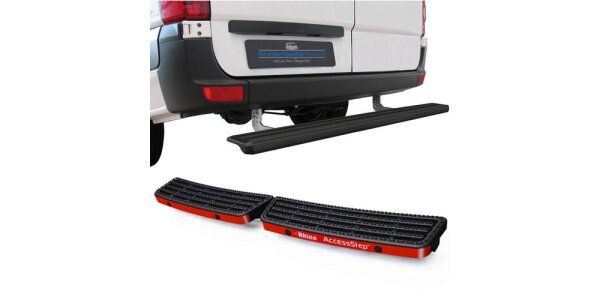
WIKI Guide: Rear Steps for Vans & Commercial Vehicles Fixed rear step, stainless-steel version, Easy Step, wide AccesStep or a rear step with additional impact protection? This guide explains
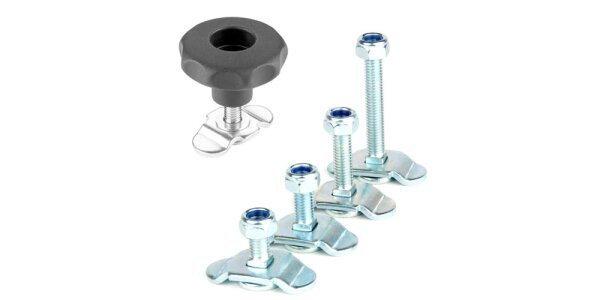
Kurierbedarf Technical Guide – Quick OverviewTopic: Threaded fittings for Airline RailsThread: M8Materials: zinc-plated steel or V2A stainless steelVersions: self-locking nut or star
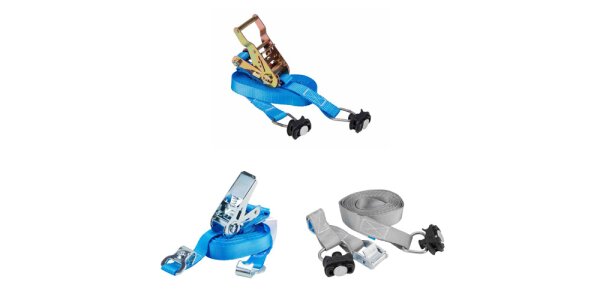
Sometimes checking the clearance shelf really does pay off. We currently have three different load securing straps available at heavily reduced prices. All three are manufactured in accordance with

If you regularly transport ladders, pipes, profiles or other long loads with a van, you need more than just additional roof space. The roof rack must match the vehicle, the permitted roof load and the