Payment by Invoice |
 How to find our store
 info@kurierbedarf.com
 Purchasing for Swiss customers
WIKI Guide: Rear Steps for Vans & Commercial Vehicles
Fixed rear step, stainless-steel version, Easy Step, wide AccesStep or a rear step with additional impact protection? This guide explains the differences between the main types of van rear steps and shows what to consider when it comes to vehicle compatibility, tow bars, parking sensors, load capacity and everyday use.
If you regularly access the load area through the rear doors of a van, the height between the ground and the load floor can make a noticeable difference during the working day. A van rear step creates an intermediate step between the ground and the cargo area, making rear access easier when entering, leaving, loading or unloading the vehicle.
However, not every rear step works in the same way. Depending on the vehicle and application, the right solution could be a fixed steel step, stainless-steel rear step, wide access platform, height-adjustable system or rear step with additional impact protection. A fitted tow bar and existing parking sensors can also have a major influence on compatibility.
Choosing the right rear step should therefore start with the vehicle and its equipment – not simply with appearance, size or price.
Which rear step fits my van?
Quick answer: The correct rear step depends primarily on the vehicle model, model year or generation, tow bar and parking sensor configuration. For everyday commercial use, step size, position, access height, load capacity and construction are also important. Vans with a tow bar require a compatible rear step, while vehicles with parking sensors need a system that takes the position and operation of those sensors into account.
Why use a rear access step on a commercial van?
For occasional access, the height of a van's load floor may not seem particularly important. The situation changes when a driver, technician or delivery worker enters and leaves the cargo area dozens of times during a working day.
A rear access step creates an additional intermediate level. Instead of covering the complete distance between the ground and the load floor in one movement, the user has an additional step in between. It can also provide a useful standing area when loading or unloading through the rear doors.
Rear steps are therefore particularly useful for:
- courier, express and parcel delivery vehicles
- trades and installation vans
- service and maintenance vehicles
- workshop and field-service vans
- delivery and logistics vehicles
- commercial fleets with frequent cargo-area access
- camper vans and converted panel vans
Practical tip: The more frequently the rear load area is accessed, the more important the size, position and height of the step become. A compact step may be perfectly adequate for occasional use, while a wide platform can be much more practical for intensive delivery or service work.
What types of van rear steps are available?
Different rear-step designs solve different problems. Some are designed around simplicity and durability, while others provide a particularly wide standing area or are specifically designed to work with a tow bar. Other systems focus on reducing the access height or combine a step with additional rear impact protection.
| Type | Design | Main advantage | Typical application |
|---|---|---|---|
| Fixed rear step | Simple, robust and low-maintenance | Permanent and straightforward access aid | Trades, service and delivery vehicles |
| Stainless-steel rear step | Robust and corrosion-resistant | Different step positions and configurations | Commercial vehicles with or without tow bar |
| Easy Step | Designed around easier access | Height and depth can be adjusted during installation | Frequent entry and exit |
| AccesStep | Wide rear access platform | Large standing and stepping area | Delivery, trades, service and fleets |
| Rear step with impact protection | Access step with additional protective function | Impact-absorbing construction at the rear | Delivery fleets and frequent manoeuvring |
Fixed rear steps – the robust everyday solution
Fixed rear steps are among the most straightforward solutions for commercial vans. They remain permanently in position and require neither electrical components nor an extending mechanism.
This makes them particularly useful when a robust, low-maintenance and permanently available access step is required. Many versions use corrosion-protected or hot-dip galvanised steel and feature a structured stepping surface for reliable grip.
There are considerable differences within this category, however. Options range from compact single-sided steps to vehicle-specific platforms and wider or split designs intended to accommodate tow bars.
Important: Load capacity is not identical across all fixed rear steps. Always use the specification for the individual product rather than assuming one general load rating.
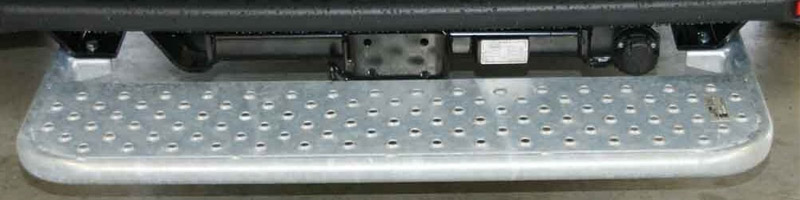
Stainless-steel rear steps – different positions for different jobs
Stainless-steel rear steps provide a permanently installed access point and combine robust construction with good corrosion resistance.
One of their advantages is the range of available configurations. Depending on the vehicle, rear steps may be positioned centrally, as a split left/right system, or individually on the left or right side.
| Configuration | Layout | Typical advantage |
|---|---|---|
| Central | Step positioned in the centre of the vehicle | Direct central access to the load area |
| Split | Left and right steps with an open centre section | Can provide space around a tow bar |
| Left | Single step on the left | Defined access point for specific vehicle use |
| Right | Single step on the right | Defined access point for specific vehicle use |
Practical recommendation: The widest possible step is not automatically the best solution. If the load area is normally accessed through one side of the rear doors, or if the centre needs to remain clear for a tow bar, a smaller or split configuration may be more practical.
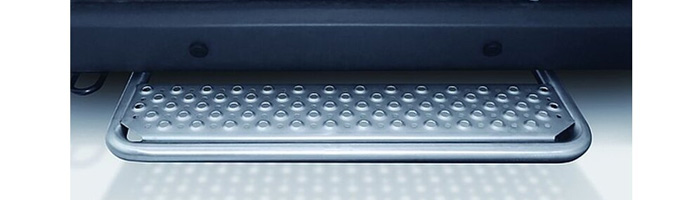
Easy Step – when reducing the access height matters
The Easy Step is designed with easier rear access in mind. The position of the step can be adjusted in height and depth during installation to suit the application.
Its open aluminium stepping surface allows water and dirt to drain away, while galvanised steel brackets provide a stable mounting structure. According to the system specifications, the step can reduce the height that needs to be covered when entering the vehicle by approximately 25 cm.
This intermediate step can be particularly useful on vehicles where the rear load area is accessed repeatedly throughout the day.
Easy Step can be particularly useful when:
- the cargo area is accessed very frequently,
- the original load-floor height makes entry less convenient,
- an open surface that allows water and dirt to drain is preferred,
- the position of the step needs to be adjusted during installation.
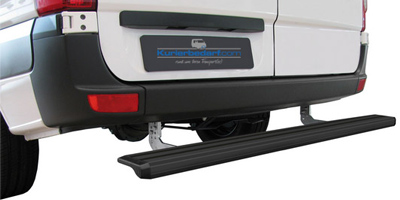
AccesStep – a wide platform for frequent rear access
The AccesStep for vehicles without a tow bar takes a different approach. Instead of providing a small stepping point, it creates a wide platform across a substantial part of the rear of the vehicle.
The system combines a robust steel frame with a slip-resistant, glass-fibre-reinforced stepping surface. Different widths and configurations are available depending on the vehicle. The relevant AccesStep versions have a maximum load capacity of 136 kg.
A wide platform can be particularly useful when the user does not always step into or out of the vehicle at exactly the same point. It also provides additional standing space when working at the open rear doors.
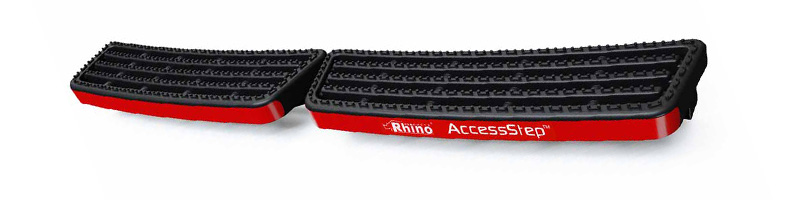
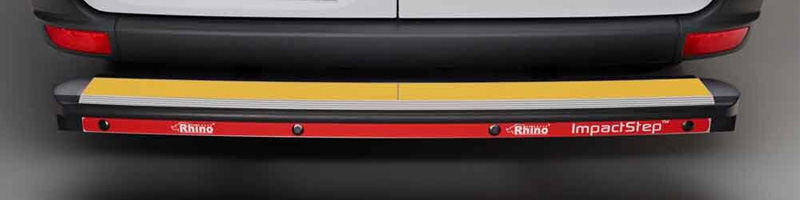
Rear steps with impact protection – access and protection combined
A rear step with additional impact protection does more than simply provide easier access. Its construction is also designed to absorb or cushion smaller impacts and loads at the rear of the vehicle.
This can be particularly useful for vehicles that regularly reverse towards loading bays, loading areas or other vehicles. Typical applications include parcel delivery, logistics fleets and other commercial vehicles that perform frequent manoeuvres during the working day.
Important: Impact protection does not make the step a substitute for the vehicle's safety systems and does not prevent all accident damage. It should be understood as an additional protective function for typical low-level impacts and stresses encountered during commercial use.
Rear step with or without a tow bar?
An existing or planned tow bar is one of the most important factors when selecting a rear step. A step designed for a vehicle without a tow bar may occupy the same installation space needed by the towing system.
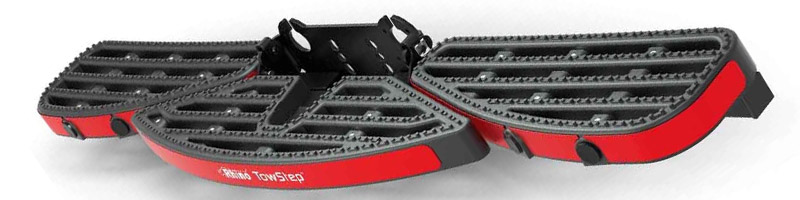
Several solutions are available for vehicles with tow bars. Depending on the vehicle and towing system, these can include split steps, side-mounted steps and rear steps designed specifically for 2- or 4-bolt tow bars.
The rear steps for vehicles with tow bars and optional parking-sensor compatibility are designed specifically around this requirement.
| Vehicle configuration | Possible solution | Check before ordering |
|---|---|---|
| No tow bar fitted or planned | Central or wide rear step | Vehicle-specific compatibility |
| Tow bar fitted | Split, side-mounted or tow-bar-specific step | Tow bar type and mounting arrangement |
| 2- or 4-bolt tow bar | Rear step designed for the relevant flange system | Bolt pattern and tow bar crossmember |
Practical tip: Even if the vehicle does not currently have a tow bar, consider whether one may be fitted later. Choosing a large central rear step now can limit the options for adding a towing system in the future.
What is a 2- or 4-bolt tow bar?
On many commercial vehicles, the tow ball is attached to the towing crossmember using a bolted flange connection. Depending on the system, the flange uses two or four mounting bolts.
Specific rear steps are available for these towing systems and can be installed together with a compatible tow bar. However, knowing that a vehicle simply “has a tow bar” is not always enough. The tow bar design, bolt pattern, crossmember and exact installation arrangement may all affect compatibility.
Common mistake: Ordering a rear step described as suitable “for tow bars” without checking the type of tow bar already installed on the vehicle.
Can a rear step be used with parking sensors?
Modern commercial vans often use rear parking sensors. Because a rear step adds a new structure behind the vehicle, it can enter the detection area of the sensors.
For this reason, it would be misleading to say that all rear steps automatically work with parking sensors. Compatibility depends on the individual vehicle and step system.
With certain AccesStep and tow-bar versions, the vehicle's existing parking sensors can be removed from the bumper and repositioned in designated locations within the rear step. Extension wiring can then be used to reconnect the sensors to the vehicle.
Other step systems may require a different solution. Sensor positions can be affected differently depending on the vehicle and the construction of the rear step.
Check before ordering: Does the vehicle have rear parking sensors? How many sensors are fitted? Is the selected rear step specifically designed for use with them? Are the original sensors repositioned, or does the step affect their operation? Always use the information provided for the exact vehicle and rear-step combination.
How wide should a van rear step be?
The size of the stepping surface influences how the rear step can be used in everyday work. A small side-mounted step provides a compact and clearly defined access point. A wide platform gives the user more freedom to move across the rear of the vehicle.
| Design | Advantage | Typical use |
|---|---|---|
| Compact / side-mounted step | Compact construction | Defined access point |
| Split rear step | Left and right access with an open centre section | Vehicles with a tow bar |
| Wide rear platform | Large standing and stepping area | Frequent loading, unloading and changing access positions |
A wide tow-bar-compatible rear step can, for example, provide a stepping area approximately 1,462 mm wide and 181 mm deep. This illustrates the considerable difference between a full-width access platform and a compact individual step.
Which rear step is best for different types of work?
Vehicle compatibility determines which rear steps can be fitted. The way the vehicle is used then determines which of those options is likely to be the most practical.
| Application | Main priority | Suitable type to consider |
|---|---|---|
| Parcel / courier delivery | Very frequent entry and exit | Wide or ergonomically positioned rear step |
| Trades | Durability and straightforward operation | Fixed steel or stainless-steel step |
| Service vehicle | Comfort during regular cargo-area access | Easy Step, AccesStep or fixed rear step |
| Regular trailer use | Clearance and tow-bar compatibility | Split or tow-bar-specific rear step |
| Frequent manoeuvring | Additional protection at the rear | Rear step with impact protection |
| High load-floor access | Useful intermediate stepping height | Easy Step or appropriately positioned fixed step |
Which vans can be fitted with rear steps?
Rear access steps are available for many popular light and heavy commercial vans. Vehicle families include, among others:
- Mercedes-Benz Sprinter
- Volkswagen Crafter and MAN TGE
- Ford Transit and Transit Custom
- Fiat Ducato, Citroën Jumper and Peugeot Boxer
- Renault Master, Nissan Interstar / NV400 and Opel Movano
- Iveco Daily
- as well as other vans and light commercial vehicles.
The vehicle name alone is not enough to guarantee compatibility. Within a single model range, the generation, model year, drivetrain, chassis and rear equipment can vary.
| Check | Why it matters |
|---|---|
| Make and model | Starting point for vehicle compatibility |
| Model year / generation | Mounting points and vehicle construction can change |
| Drivetrain | Can affect installation on certain vehicle models |
| Tow bar | Changes the available installation space at the rear |
| Parking sensors | Sensor operation must be compatible with the selected step |
Stainless steel, steel, aluminium or composite?
Rear steps can use several different materials depending on their design. A simple “material A is better than material B” comparison is not particularly useful because many rear-step systems combine several materials within the same construction.
| Material | Characteristics | Typical use |
|---|---|---|
| Stainless steel | Corrosion-resistant and durable | Rear steps and visible stepping surfaces |
| Galvanised / coated steel | Strong and robust | Frames, brackets and fixed steps |
| Aluminium | Lightweight and corrosion-resistant | Stepping surfaces and specialised constructions |
| Glass-fibre-reinforced composite | Robust, weather-resistant and suitable for textured surfaces | Wide slip-resistant stepping platforms |
The important factor is therefore the overall construction of the rear step, not simply the material used for one individual component.
How much weight can a van rear step support?
Maximum load capacity varies between rear-step systems. A compact tow-bar-mounted step may have a different rating from a heavy-duty vehicle-specific steel step or a wide AccesStep platform.
For this reason, the load rating from one rear step should never be assumed to apply to another. Always refer to the maximum load specified for the individual product.
Practical rule: For intensive commercial use, consider not only maximum load capacity but also step dimensions, mounting method and intended application. A high kilogram rating alone does not tell you which rear step will be the most practical during a working day.
Installation: why vehicle-specific compatibility matters
Many rear steps are installed using vehicle-specific brackets or designated mounting areas on the vehicle. Other systems are mounted in combination with a compatible tow bar.
This is why finding the vehicle name in the product description is only the first step. The rear step must match the exact vehicle configuration.
After installation, the fixings should be checked in accordance with the installation instructions. The step should also be inspected regularly for secure mounting, visible damage and wear.
6 common mistakes when choosing a van rear step
- Choosing by vehicle name alone: “Mercedes Sprinter” or “Ford Transit” may not provide enough information. Model year, generation and, where relevant, drivetrain must also match.
- Forgetting about the tow bar: Not every rear step leaves sufficient space for a towing system.
- Checking only whether a tow bar is fitted: Tow-bar-specific steps may also depend on the exact design and mounting arrangement.
- Ignoring parking sensors: A rear step can enter the detection area of the sensors, so compatibility needs to be checked before ordering.
- Choosing only by load capacity: Step size, position and access height can be just as important in everyday use.
- Not considering future vehicle equipment: If a tow bar is likely to be added later, a central rear step selected today could restrict future options.
A practical way to choose the right rear step
A simple selection process can prevent many compatibility problems:
- Identify the vehicle: make, model, model year and generation.
- Check the configuration: drivetrain and any other relevant vehicle-specific features.
- Check the tow bar: none fitted, already installed or planned for the future?
- Check the parking sensors: are they fitted, and how does the selected step accommodate them?
- Define the application: occasional access, daily service work, intensive parcel delivery, trailer use or additional rear protection?
- Then choose the step type: fixed, stainless steel, Easy Step, AccesStep or a system with impact protection.
This order helps avoid choosing a rear step because it looks suitable or has an attractive specification, only to discover that it does not match the vehicle configuration or the way the van is actually used.
Before ordering: van rear step checklist
- What is the exact vehicle make and model?
- What is the model year and vehicle generation?
- Does the drivetrain affect compatibility?
- Is a tow bar fitted?
- If yes, what type of tow bar is installed?
- Could a tow bar be fitted in the future?
- Does the vehicle have rear parking sensors?
- How often is the cargo area accessed through the rear?
- Is a compact step sufficient, or is a wide standing platform preferable?
- Would additional rear impact protection be useful?
- What load capacity is required for the intended application?
The best rear step is the one that fits the job
A good van rear step does not need to be the largest, heaviest or most complicated option. It needs to fit both the vehicle and the way the vehicle is used.
For a tradesperson, a straightforward fixed steel or stainless-steel step may be exactly the right solution. For intensive parcel delivery, a wide or ergonomically positioned platform may provide more practical benefit. Regular trailer use requires sufficient clearance and compatibility with the tow bar, while vehicles that frequently manoeuvre in loading areas may benefit from a step with additional impact protection.
By checking the vehicle, tow bar, parking sensors and intended use first, it becomes much easier to identify the right type of rear step – and to avoid one of the most common mistakes: choosing a perfectly good step for the wrong van.
FAQ – Rear Steps for Vans & Commercial Vehicles
Which rear step fits my van?
The main factors are the vehicle make and model, model year or generation and, where relevant, the drivetrain. A fitted tow bar and rear parking sensors must also be considered before choosing between a fixed step, stainless-steel version, Easy Step, AccesStep or a system with additional impact protection.
Can I fit a rear step if my van has a tow bar?
Yes, provided the rear step is compatible with the installed towing system. Depending on the vehicle and tow bar, suitable options can include split, side-mounted or dedicated 2- or 4-bolt tow-bar steps. The exact tow bar design should always be checked before ordering.
Will the parking sensors still work with a rear step?
This depends on the vehicle and rear-step system. On certain versions, the original parking sensors can be repositioned in the rear step. Other systems may affect individual sensor positions differently. Always check parking-sensor compatibility for the exact vehicle and step combination.
What are the advantages of a wide rear step?
A wide rear step provides a larger standing and stepping area across the back of the vehicle. This can be particularly useful during frequent loading and unloading or when the user does not always enter and leave the van at the same position.
What is the advantage of an Easy Step?
The Easy Step provides an intermediate step and can be adjusted in height and depth during installation. Its open aluminium surface allows water and dirt to drain away, and the system can reduce the height that needs to be covered when entering the vehicle by approximately 25 cm.
When is a rear step with impact protection useful?
A rear step with additional impact protection can be useful for delivery, logistics and fleet vehicles that perform frequent reversing and manoeuvring. It combines easier cargo-area access with an additional impact-absorbing function at the rear of the vehicle.
How much weight can a van rear step support?
Maximum load capacity varies according to the design and model. Always use the load rating specified for the individual rear step rather than assuming one general value for all systems.