 Payment by Invoice |
 How to find our store
 info@kurierbedarf.com
 Purchasing for Swiss customers
Safe load securing is a key issue in everyday trade, service and logistics. Whether in vans, trailers or commercial vehicles: unsecured or incorrectly secured loads can slip, tip over or, in the worst case, cause accidents. In practice, a fundamental question often arises: Lashing strap with clamp lock or lashing strap with ratchet – which system is the right choice for which application?
Both variants fulfill their purpose, but differ significantly in terms of functionality, tensioning force and typical areas of application. This article explains the most important differences, shows the strengths and limitations of both systems and helps you to choose the right solution for your own everyday transportation needs.
Basics of load securing with lashing straps
Lashing straps are used to secure loads against slipping, tipping or falling over. Depending on the application, securing is achieved either by lashing down (contact pressure) or form-fit securing (e.g. by direct fixation). The decisive factor here is how much force is applied to the webbing in a controlled manner – this is where clamp lock and ratchet differ fundamentally.
Regardless of the tensioning system, the following applies: The lashing strap must be undamaged and have a clear marking (label). Damaged straps or straps without a legible label should no longer be used.
Lashing strap with clamp lockA lashing strap with clamp lock is a practical solution for gently securing light loads. The clamp lock works without any mechanical – the tension is applied exclusively by hand. This means that there is no high pre-tensioning force, which is a particular advantage with sensitive objects.
How the clamp lock works
The webbing is fed through the buckle and then pulled taut by hand. By closing the lever, the buckle locks the strap in place using friction. A strong pre-tensioning force as with a ratchet is not possible due to the design - which is exactly what makes the system so controlled.
Advantages of clamp lock lashing straps
- Gentle on sensitive loads: Ideal for furniture, cardboard goods, electrical appliances or painted surfaces, as there is no high contact pressure.
- Low risk of pressure marks: Less risk of belts leaving marks on the transported goods
- Fast handling: Particularly practical for frequent loading and unloading in everyday life.
- Controlled tension: The risk of overtightening is reduced as the tension is only hand-tight.
Limitations of the clamp lock
A turnbuckle lashing strap is not designed to secure heavy loads using high contact forces. As soon as very high forces are required (e.g. heavy machinery or palletized goods), the system reaches its limits. For such cases, ratchet lashing straps are the better choice.
Lashing strap with ratchet
A lashing strap with ratchet is the standard when it comes to high loads and professional load securing. The ratchet has a mechanical transmission, which means that a significantly higher pre-tensioning force can be generated with comparatively little manual force.
How the ratchet works
The webbing is threaded into the ratchet and tensioned in stages using ratchet movements. The lever mechanism creates a higher pre-tensioning force, which can be decisive when lashing down. This means that even heavy or dimensionally stable goods can be reliably secured.
Advantages of ratchet lashing straps
- High pre-tensioning force: Suitable for heavy loads and applications with high securing requirements.
- Professional continuous use: Standard in the construction industry, logistics and commercial transportation.
- Flexible use: Different lengths, belt widths and end fittings enable custom-fit solutions.
- Suitable for heavy goods: Ideal for machines, building materials, pallets or heavy tools.
What to look out for with the ratchet
The high clamping force is an advantage – but can also be a disadvantage if used incorrectly. Sensitive loads can be damaged if the clamping force is too high. In such cases, either a protective pad or the use of a turnbuckle lashing strap is the better decision.
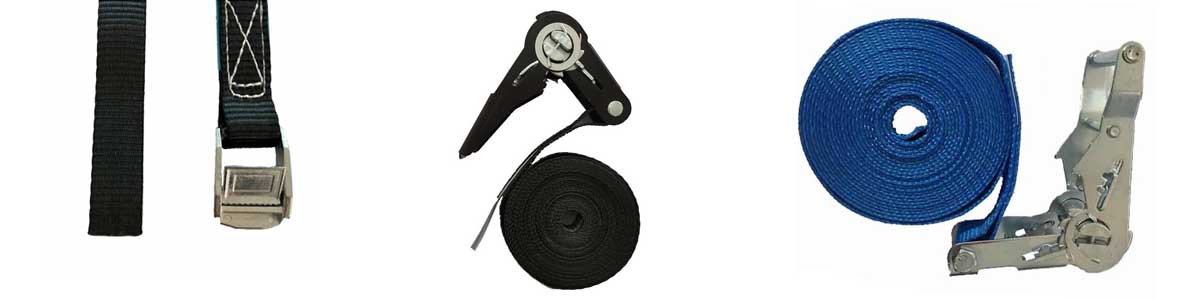
Direct comparison: clamp buckle vs. ratchet
The differences are best compared using typical criteria. The following overview helps with a quick classification:
Tension force and control
Clamp lock: controlled, hand-tight clamping force – ideal if a high clamping force is not required.
Ratchet: high pre-tensioning force thanks to mechanical ¨translation – ideal for heavy loads.
Protection of the transported goods
Clamp lock: very gentle on the material, low risk of pressure marks.
Ratchet: higher risk of damage if tensioned too tightly.
Handling in everyday life
Clamp lock: quick and uncomplicated, especially for frequent handling.
Ratchet: somewhat more complex, but significantly more powerful.
Range of application
Clamp lock: light to medium, sensitive loads (e.g. furniture, boxes, equipment).
Ratchet: medium to heavy loads (e.g. machines, building materials, pallets).
Practical examples: Which solution fits when?
Moving and relocation transports
For furniture, sensitive surfaces and goods that are sensitive to transportation, the lashing strap with clamp lock is often the better choice. The controlled tensioning force reduces the risk of pressure points and damage during transportation.
Handicraft vehicleA combination often makes sense in the trades: light parts can be secured gently with a clamp lock, while heavy machines or tools are better secured with ratchet lashing straps. This way, the vehicle is optimally equipped for different situations.
Construction site and logisticsThe ratchet lashing strap is standard in many cases on construction sites and in logistics. High loads and frequent load changes require powerful securing, which is often not sufficiently possible with clamp buckles alone.
Conclusion: Both systems have their place
There is no one-size-fits-all „better“ or „worse“ – the decisive factor is the intended use. clamp lock lashing straps are ideal when gentle, controlled securing of light loads is required. Ratchet lashing straps are the right choice when high pre-tensioning force and maximum stability are required.
In practice, a combination of both systems often proves successful: Those who carry both clamp lock and ratchet lashing straps in the vehicle are flexibly equipped for almost any transport situation - and can secure loads safely, efficiently and in a way that protects the material.
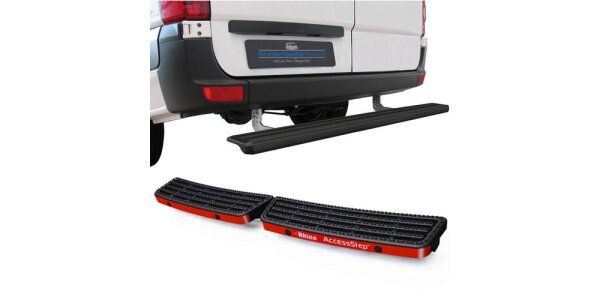
WIKI Guide: Rear Steps for Vans & Commercial Vehicles Fixed rear step, stainless-steel version, Easy Step, wide AccesStep or a rear step with additional impact protection? This guide explains
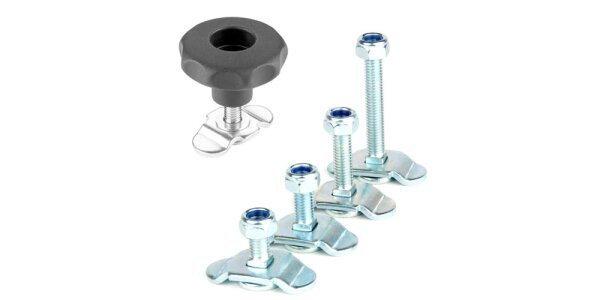
Kurierbedarf Technical Guide – Quick OverviewTopic: Threaded fittings for Airline RailsThread: M8Materials: zinc-plated steel or V2A stainless steelVersions: self-locking nut or star
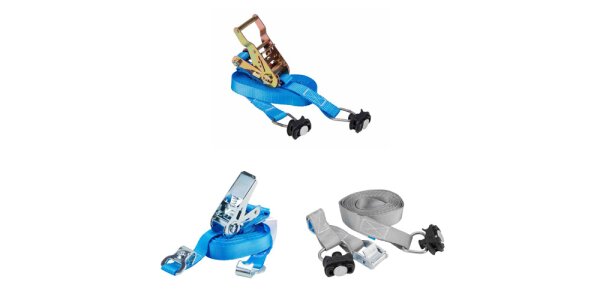
Sometimes checking the clearance shelf really does pay off. We currently have three different load securing straps available at heavily reduced prices. All three are manufactured in accordance with

If you regularly transport ladders, pipes, profiles or other long loads with a van, you need more than just additional roof space. The roof rack must match the vehicle, the permitted roof load and the