Payment by Invoice |
 How to find our store
 info@kurierbedarf.com
 Purchasing for Swiss customers
Sometimes checking the clearance shelf really does pay off. We currently have three different load securing straps available at heavily reduced prices. All three are manufactured in accordance with DIN EN 12195-2, but they differ significantly in their end fittings, tensioning mechanisms, lashing capacities and intended applications.
The clearance range includes a 3.5 m cam buckle strap with Airline Rail fittings, a 6 m ratchet strap with flat hooks for slotted cargo rails and a stronger 6 m ratchet strap with Airline Rail fittings.
All three straps are heavily reduced clearance items and available in limited quantities only. Once our remaining stock of a particular version has been sold, that product will no longer be available.
Which of these three clearance straps is right for my application?
In short: For vehicles equipped with Airline Rails, you can choose between a lightweight 3.5 m cam buckle strap rated at LC 250/500 daN and a stronger 6 m ratchet strap rated at LC 500/1000 daN. For compatible slotted cargo rails, the 6 m ratchet strap with flat hooks offers LC 400/800 daN. The right choice depends on your existing rail system, required strap length, cargo and load securing method.
Three load securing straps compared
| Feature | 3.5 m Airline Rail | 6 m Slotted Rail | 6 m Airline Rail |
|---|---|---|---|
| Length | 3.5 m | 6 m | 6 m |
| Webbing width | 25 mm | 25 mm | 25 mm |
| Tensioning device | Cam buckle | Compact ratchet | Standard ratchet |
| End fittings | Airline Rail fittings | Flat hooks | Airline Rail fittings |
| Rail system | Airline Rail | Slotted cargo rail | Airline Rail |
| LC | 250/500 daN | 400/800 daN | 500/1000 daN |
| STF | – | 120 daN | 150 daN |
| Standard | DIN EN 12195-2 | DIN EN 12195-2 | DIN EN 12195-2 |
1. Quick and simple: 3.5 m cam buckle strap for Airline Rails
The first option is a 3.5 m long, 25 mm wide cam buckle strap. Both the fixed and loose ends are equipped with Airline Rail fittings, allowing the two-piece strap to connect directly to a compatible Airline Rail.
With a rating of LC 250/500 daN, this version is particularly useful when lighter cargo needs to be quickly restrained, held in position or bundled. The webbing is tensioned manually and then held by the cam buckle.
This is also the main difference between this strap and the other two clearance products: the cam buckle version has no ratchet mechanism. It is therefore intended for applications where the higher pre-tensioning force provided by a ratchet strap is not required.
Our recommendation: A practical choice for users who already have Airline Rails installed and need a straightforward strap for quickly restraining lighter loads.

2. For slotted cargo rails: 6 m ratchet strap with flat hooks
If your vehicle uses slotted cargo rails, a different type of end fitting is required. That is where our second clearance strap comes in.
This two-piece 6 m ratchet strap with 25 mm webbing features flat hooks on both the fixed and loose ends. The hooks connect directly to a compatible slotted load securing rail, while the compact ratchet allows the webbing to be tensioned.
The strap is rated at LC 400/800 daN and has an STF of 120 daN. It therefore differs from the cam buckle strap not only in the rail system it is designed for, but also in the way tension is applied.
Our recommendation: The appropriate option from these three products if your vehicle is equipped with compatible slotted cargo rails and you need a two-piece ratchet strap with flat hooks.

3. Higher LC and standard ratchet: 6 m strap for Airline Rails
The third strap combines direct attachment to an Airline Rail with a standard ratchet. Like the 3.5 m cam buckle version, both the fixed and loose ends feature Airline Rail fittings, so no separate fittings are required for connection to a compatible rail.
With a 6 m length, LC 500/1000 daN and STF 150 daN, this model has the highest specified LC and STF values of the three clearance products.
The standard ratchet allows the 25 mm webbing to be tensioned in a controlled manner. Multiple attachment positions along an Airline Rail also make it possible to select suitable securing points for different cargo sizes and positions.
Our recommendation: If your vehicle uses Airline Rails and you need a longer ratchet strap with higher LC and STF values within this clearance range, this is the version to look at first.

Airline Rail or slotted cargo rail – the end fitting must match
One common mistake when choosing a load securing strap is to look only at length, webbing width and load rating. The type of end fitting is just as important.
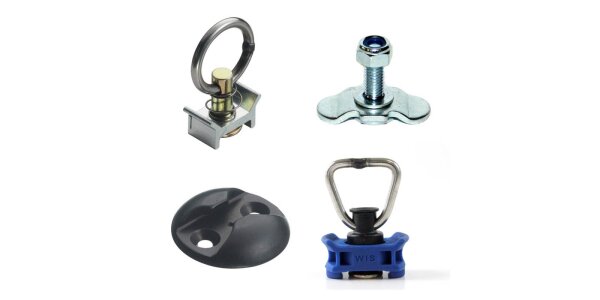
An Airline Rail fitting is designed to engage with the corresponding mounting points of a compatible Airline Rail. A flat hook for a slotted cargo rail, on the other hand, uses the openings provided by that particular rail system.
Before choosing a strap, first identify which load securing rail system is actually installed in your vehicle. Once that is clear, you can compare strap length, LC, STF and the tensioning mechanism.
Cam buckle or ratchet – what is the difference?
The tensioning mechanism has a major influence on how a load securing strap can be used.
With a cam buckle strap, the webbing is pulled tight by hand and held in position by the buckle. This makes it convenient for applications where items need to be quickly restrained, held in position or bundled.
A ratchet strap uses a mechanical tensioning device to apply tension to the webbing. This is why ratchet straps also carry values such as STF (Standard Tension Force), which is particularly relevant for frictional lashing.
Important: A higher LC or STF does not automatically mean that a particular strap is suitable for every load or every securing method. The required load securing system must always be selected according to the cargo and the specific transport situation.
LC and STF – two values with different meanings
Labels on load securing straps often include abbreviations such as LC and STF. They describe different characteristics and should not be confused.
LC (Lashing Capacity) indicates the permitted force for which the lashing equipment is rated. For example, a strap marked LC 500 daN has a lashing capacity of 500 daN in straight pull. In an appropriate loop configuration, both strap sections are taken into account, which is why ratings such as 500/1000 daN are commonly shown.
STF (Standard Tension Force) refers to the standard pre-tensioning force generated by the tensioning device under defined conditions. This value is particularly relevant when using frictional lashing.
5 things to check before choosing your strap
- Rail system: Airline Rail or slotted cargo rail?
- End fitting: Does the fitting or hook match the rail installed in your vehicle?
- Strap length: Is 3.5 m sufficient or do you need a 6 m strap?
- Tensioning mechanism: Is a cam buckle suitable, or is a ratchet required?
- LC and STF: Are the specified values appropriate for the intended load and securing method?
Practical tip: Do not wait until the strap has been tensioned to check the end fittings. Airline Rail fittings and flat hooks should be fully and securely engaged in their intended mounting points before tension is applied.
Check the strap and attachment points before every journey
Whichever of the three straps you use, the webbing, stitching, ratchet or cam buckle and all end fittings should be checked for visible signs of damage before use.
The rail system itself is equally important. The Airline Rail or slotted cargo rail and its attachment to the vehicle must be suitable for the forces generated during load securing. A strong ratchet strap cannot compensate for an unsuitable or insufficiently secured mounting point.
Three different solutions – only while stocks last
These three clearance offers cover distinctly different applications. The 3.5 m cam buckle strap provides a straightforward option for Airline Rails and lighter securing tasks. The 6 m strap with flat hooks is designed for compatible slotted cargo rails. And the 6 m ratchet strap with Airline Rail fittings combines direct Airline Rail attachment with a standard ratchet, LC 500/1000 daN and STF 150 daN.
All three versions are manufactured in accordance with DIN EN 12195-2 and are currently available at heavily reduced clearance prices.
But this really is a case of while stocks last: The special prices apply only to our remaining inventory. Once a version has sold out, it will no longer be available.