Payment by Invoice |
 How to find our store
 info@kurierbedarf.com
 Purchasing for Swiss customers
For many trades and service companies, vans are more than just vehicles - they are rolling workshops, material stores and mobile workstations all in one. However, with an increasing variety of tools, ever larger components and more complex construction sites, the interior space quickly reaches its limits. This is where a professional roof rack comes into play - not as an accessory, but as a strategic extension of vehicle use.
In this article, we show why modern Aluminium roof racks from Rhino's KammRack series are much more than simple crossbars today, what is important when choosing them and how companies can save time, fuel and nerves with well thought-out roof systems.
From a simple carrier to a modular transport system
In the past, a roof rack often consisted of simple steel profiles that were primarily used to transport a ladder. Today, professional systems are much more advanced. Modern aluminium roof racks offer aerodynamically optimized profiles, modular extension options and vehicle-specific adaptations that are precisely matched to the wheelbase, roof shape and fixed points.
The decisive difference lies in the system concept: instead of improvising individual components, a structured loading area is created on the vehicle roof. Transport tubes, ladder brackets, running plates or securing systems interlock and form a functional unit.
Why aerodynamics play a bigger role in everyday life than expected
A roof spoiler influences driving behavior more than many people think. Especially when driving on the highway, angular constructions cause wind noise and increased air resistance. Modern aluminium profiles therefore rely on flow-optimized tube shapes that reduce turbulence.
The result is not only reflected in subjective driving comfort, but also measurably in fuel consumption and, in the case of electric vehicles, in range. Especially for companies with high mileage, an aerodynamic design can pay off financially in the long term.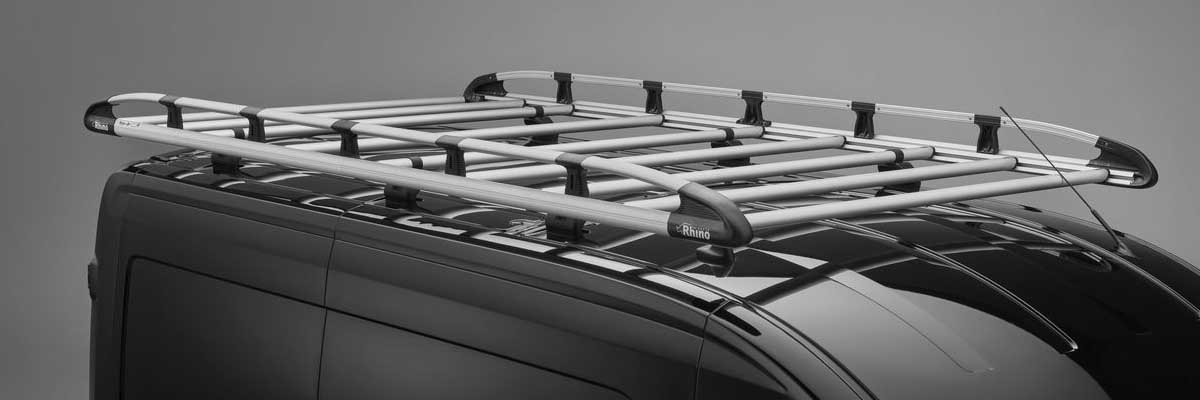
Material comparison: aluminum vs. steel
A key decision criterion is the material. While classic systems are often made of steel, high-quality roof frames today rely on galvanized or anodized aluminium.
Aluminum offers several advantages:
It is significantly lighter than steel, which reduces the roof load and has a positive effect on vehicle dynamics. At the same time, it is corrosion-resistant - an important factor for year-round use in rain, snow and road salt. In addition, the appearance remains high-quality in the long term, which is particularly important for prestigious service vehicles.
Steel, on the other hand, scores points for extreme point loads, but is heavier and more susceptible to rust if it does not have a high-quality coating.Safety aspects: Why 20g crash tests are crucialA professional roof rack from Rhino has to do more than just carry weight. In the event of emergency braking or an accident, enormous forces act on the structure. That is why tested systems in accordance with ECE guidelines and with a 20g crash test are an important quality feature.
These tests simulate extreme load situations and ensure that neither the carrier nor the load will come loose in an uncontrolled manner. For commercial operations, this not only means safety for drivers and the surrounding area, but also legal protection in the event of damage.
Ergonomics on the roof: save time on every jobMany people underestimate the amount of time it takes to load and unload. Straight ladders, pipes or long profiles require strength and coordination. Integrated rear rollers make it much easier to push on material. Instead of lifting the load, it is rolled up in a controlled manner.
Ladder clamps with a quick-release mechanism are just as important. While conventional lashing straps have to be repositioned each time, modern clamping systems enable a much quicker fixation - while at the same time providing greater theft protection.If you calculate time savings of just a few minutes per use, this adds up to a considerable gain in productivity over months.
Electric vans and roof load – what needs to be considered
With the growing proportion of electric commercial vehicles, the consideration of the roof rack is also changing. In addition to the classic payload, aerodynamic efficiency plays an even greater role here, as additional air resistance directly influences the range.
In addition, the permissible roof load for electric vehicles is sometimes defined differently than for combustion models. Precise coordination between vehicle data and the roof carrier system is therefore essential.
Legal principles: load securing is mandatory
According to §22 StVO, loads must be secured in such a way that they do not slip or fall off even in the event of emergency braking or sudden evasive maneuvers. This also expressly applies to roof loads.
A tested roof rack alone is not enough – the decisive factor is professional securing with suitable fastening systems. These include certified ladder clamps, lockable transport tubes or form-fitting retaining systems.
Practical example: Increasing efficiency in HVAC operations
A medium-sized HVAC company with five service vehicles converted its fleet from simple crossbars to modular aluminum roof systems. In addition to transport tubes for copper pipes, conductor holder and running plates were integrated.
The result after six months: shorter loading times, less material damage and a noticeable reduction in noise emissions when driving on the highway. The fitters also reported significantly more ergonomic handling.
The decisive advantage lay not in a single component, but in the system solution.Maintenance and care of an aluminum roof girder
Even high-quality systems benefit from regular checks. This includes retightening the fastening screws, checking moving parts and removing dirt deposits.
Cleaning is particularly recommended after winter use to remove salt residue. Aluminum itself is corrosion-resistant, but connecting elements should be kept clean and dry.
Long-term investment instead of short-term solution
A professional roof joist is not a spontaneous accessory decision, but an investment in efficiency, safety and organization. Anyone who is on the road every day benefits from well thought-out systems that simplify work processes and protect materials.
Quality pays off in the long term, especially in a commercial environment: lower wear and tear costs, less downtime and higher employee satisfaction.
Conclusion: The roof as a strategic utility area
Modern roof bars from Rhino transform the vehicle roof into a fully-fledged, structured transport surface. They combine aerodynamics, stability and modularity to create a system that measurably improves everyday working life.
If you view your commercial vehicle as a tool, you should also plan the roof strategically. The right solution not only creates additional storage space, but also a more efficient overall concept for mobile use.