 Payment by Invoice |
 How to find our store
 info@kurierbedarf.com
 Purchasing for Swiss customers
Lashing straps, also known as tension belts, are one of the most important aids in modern load securing. They are used in commercial freight transport as well as for private transportation or moving goods. Their main task is to prevent transport goods from slipping, tipping over or being lifted - an essential contribution to safety in road traffic.
In order for a seat belt to fulfill this task reliably, it must comply with certain standards and technical requirements. In Europe, DIN EN 12195-2 and VDI Directive 2700 apply in particular. These standards define material properties, markings and testing procedures. Only belts that comply with these specifications may be used in road traffic.
Materials and properties of lashing straps
Lashing straps are usually made of polyester (PES). This material is characterized by high tensile strength, low elongation and weather resistance. Polyester belts only stretch by around 4 to 7 percent, which ensures stable pre-tensioning - even during abrupt braking maneuvers or fast cornering.
Other materials such as polypropylene (PP) are cheaper, but are not approved for use in road traffic. They stretch by up to 30 percent, which can significantly impair load securing. For safe transportation, polyester strapping is therefore exclusively recommended.
Types and areas of application
Lashing straps are available in different versions depending on the respective transport task. The decisive factors are belt width, length and the permissible tensile force (LC or STF).
- Lightweight lashing straps (25 mm) with clamp lock – ideal for smaller loads or private removals
- Standard tensioning straps (35–50 mm) with ratchet – for transportation in cars, vans or trailers
- Professional lashing straps (up to 75 mm) with ERGO long-lever ratchet – for heavy goods up to 500 daN pre-tensioning force
The permissible load values are between 200 daN and 10,000 daN, depending on the design. This means that almost any transport task can be safely covered - from delicate cardboard boxes and palletized goods to machines or building materials.

Final fittings and fastening systems
The so-called end fittings ensure a secure connection between the belt and the vehicle. Depending on the application, they are either permanently connected or can be combined on a modular basis. The most common designs include:
- Spike hooks or snap hooks
- Flat hooks for trailers
- Ring loops
- Fittings for airline or combination lashing rails
These systems enable a precisely fitting attachment for different vehicle types - from vans to trucks and trailers.
Importance of the edge protector
An often underestimated component of load securing are edge protectors. They fulfill several important functions:
- Even distribution of the pre-tensioning force
- Protection of sensitive loads from pressure points
- Avoidance of cuts on the belt
- Extends the service life of the entire lashing system
Edge protectors prevent material damage and ensure more stable lashings, especially when transporting building materials, pallets, wood, metal profiles or cardboard packaging. At the same time, friction is reduced, which enables a higher pre-tensioning force.
Specialized lashing systems for special applications
In addition to standard lashing straps, specialized systems are often used in practice, for example:
Round slings are closed belt loops that adapt particularly well to irregular or delicate load shapes. Lifting slings offer a wide support surface and distribute the load evenly, making them ideal for the safe transportation of heavy goods.
Accessories for optimum load securing
Suitable accessories make handling easier and increase safety when lashing. These include:
- Ratchet pads to protect sensitive surfaces
- Edge protection bracket for stable belt guidance
- Anti-slip mats to increase the coefficient of friction
The use of these aids can often significantly reduce the necessary lashing force, which improves both the safety and the service life of the belts.
Care, maintenance and storage of lashing straps
To ensure that lashing straps remain fit for purpose in the long term, they should be checked regularly and stored properly. The following measures are recommended:
- Visual inspection before each use – replace damaged belts immediately
- Dry, clean storage – preferably rolled up in a bag
- Avoid direct sunlight and aggressive chemicals
- Lightly grease the ratchet mechanism to prevent corrosion
In commercial use, regular inspection is even mandatory. Defective belts must be removed from circulation immediately to ensure the safety of the load.
Standards and legal principles
Safe load securing is clearly regulated in Germany and the EU. Important regulations are:
- DIN EN 12195-2 – technical requirements for textile lashing straps
- VDI 2700 – Principles of load securing on road vehicles
- §22 StVO – Obligation to properly secure the load
Violations of these regulations can result in fines and liability claims. Correct selection and use of lashing equipment is therefore not only a safety issue, but also a legal one.
Conclusion: Safety through standard-compliant load securingLashing straps are an essential component of safe goods transportation. It is not only important to choose the right belt, but also to use and maintain it properly
Those who rely on polyester lashing straps in accordance with DIN EN 12195-2, check them regularly and use supplementary aids such as edge protection brackets or anti-slip mats ensure effective and safe load securing in both private and commercial use.
Careful handling not only protects the transported goods, but also the vehicle and all road users.
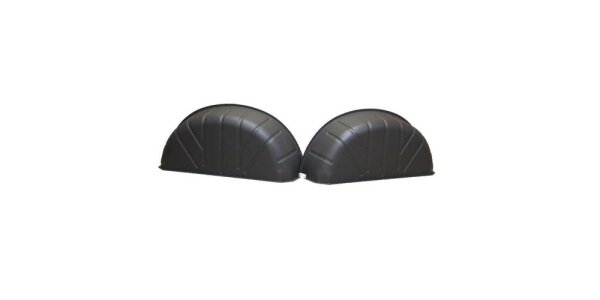
Kurierbedarf WIKI – Wheel Arch Covers for VansQuick overview: Wheel arch covers protect the projecting wheel arches inside a van's load area from the typical wear and contact caused by everyday
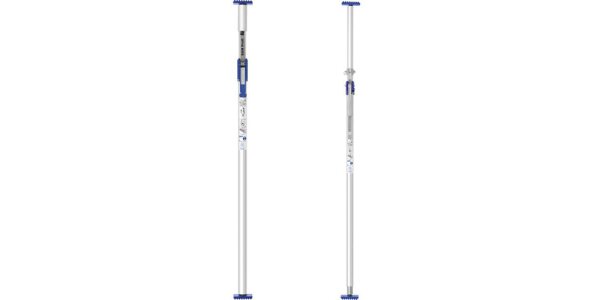
Kurierbedarf WIKI – Clamping Bars & Load Lock BarsQuick overview: Clamping bars are telescopic load-securing devices for vans, trucks, trailers and box bodies. Conventional versions are
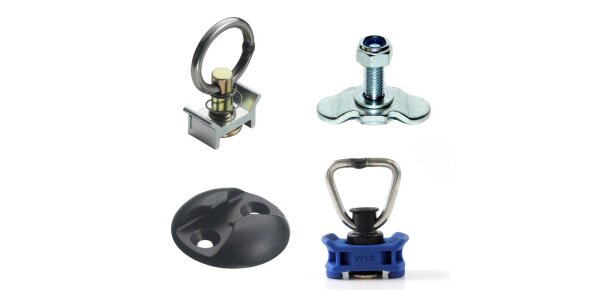
WIKI – Airline Rail AccessoriesFittings, tie-down straps, cargo bars, threaded fittings and sliding nuts turn an Airline Rail into a versatile system for load restraint and equipment mounting.
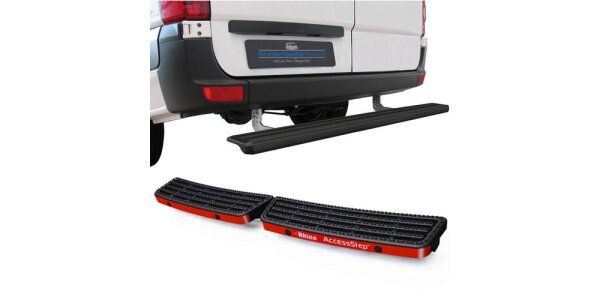
WIKI Guide: Rear Steps for Vans & Commercial Vehicles Fixed rear step, stainless-steel version, Easy Step, wide AccesStep or a rear step with additional impact protection? This guide explains