 Payment by Invoice |
  How to find our store
 info@kurierbedarf.com
 Purchasing for Swiss customers
clamping bar
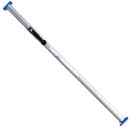
Clamping beams – also known as clamping bars or telescopic clamping beams – are a proven solution for securing loads in vans, trucks, and trailers. They are used wherever loads need to be secured quickly, flexibly, and form-fit without the need for time-consuming lashing with straps.
Typical areas of application are courier vehicles, tradesmen's vehicles, box bodies, and commercial goods transport. All clamping beams in this category meet the requirements of DIN EN 12195-1 and are therefore suitable for legally compliant load securing in road traffic.
...mehr lesen

- Renault Master, Fiat Ducato, VW Crafter, MAN TGE
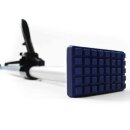
- with blue rubber feet
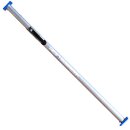
What are clamping beams and how do they work?
Clamping beams are fixed in place by simply clamping them between two load-bearing surfaces in the vehicle – for example, between side walls, partition walls, and front walls, or between the floor and roof. This creates a form-fit that reliably prevents the load from slipping.
Thanks to their telescopic design, clamping beams can be quickly adapted to different vehicle widths. Non-slip rubber feet ensure a secure hold, while the clamping mechanism generates the necessary preload force.
Clamping beams for vans, box trucks, and trucks
Different versions are available depending on the vehicle type and intended use. In this category, you will find clamping beams for vans, trucks, and trailers, including for:
- Panel vans and vans (e.g., Sprinter class)
- VW T5 / VW T6
- Truck box vehicles
- Trailers and superstructures
The clamping beams can be used both horizontally and vertically and are therefore suitable for separating loads, securing pallet goods, or supporting piece goods.
Clamping beams with rack and pinion or belt mechanism
There are two basic types of clamping bars, which differ in terms of handling and preload force:
Clamping beams with rack and pinion & clamping lever
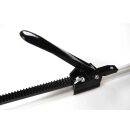
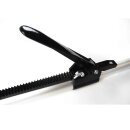
This variant is particularly robust and economical. The length is adjusted via a rack, which is tensioned by means of a lever. This allows comparatively high preload forces to be achieved. It is important to use them properly to avoid damage to the vehicle body.
Telescopic clamping beams with belt mechanism
High-quality models such as the SAM Profi 55 from :contentReference[oaicite:0]{index=0} use a protected belt mechanism for tensioning. This reduces the pre-tensioning force to a level that is gentle on the vehicle and is particularly suitable for sensitive cargo compartment walls as well as for refrigerated and freezer vehicles.
Load capacity & real securing values
The blocking force of a clamping beam that can be achieved in practice depends heavily on the conditions of use. While manufacturers' specifications sometimes indicate up to 250 daN, realistic values are usually between 100 and 140 daN.
These values depend on the surface, the condition of the rubber feet, and moisture or dirt in the cargo area. With form-fitting loading, a blocking force of 100 daN can be used to secure:
- secure up to 400 kg at the rear
- up to 200 kg can be secured in the direction of travel
For particularly heavy loads or high dynamic loads, we recommend using locking bars in combination with lashing rails.
Custom-made products & special solutions
In addition to standard lengths, custom-made clamping beams are also available. The length, design of the rubber feet, or special mountings—such as pins for airline or combination lashing rails—can be individually customized.
Your advantages with clamping beams from this category
- Clamping beams & clamping bars according to DIN EN 12195-1
- Suitable for vans, trucks, and trailers
- Can be used horizontally and vertically
- Versions with rack and pinion or belt mechanism
- Also available as custom-made products
With clamping beams and clamping bars from this category, you can secure your load efficiently, flexibly, and in accordance with standards—for optimal use of cargo space and greater safety in everyday transport.
FAQ – Clamping beams and clamping bars
What is the difference between clamping beams and clamping bars?
There is no technical difference. Clamping beams and clamping bars refer to the same product. Both are used for form-fitting load securing in the cargo space of vans, trucks, or trailers.
For which vehicles are clamping beams suitable?
Clamping beams are suitable for vans, box trucks, box trucks, and trailers. They are often used in Sprinter-class vehicles, the VW T5/T6, and commercial goods transport.
Do clamping beams comply with legal requirements for load securing?
Yes. Clamping beams in this category comply with DIN EN 12195-1 and are approved for standard-compliant load securing in road traffic, provided they are used correctly.
What is the actual load capacity of clamping beams?
In practice, the realistic blocking force is usually between 100 and 140 daN. It depends, among other things, on the surface, the condition of the rubber feet, and moisture or dirt in the cargo area.
When should I use a locking bar instead of a clamping bar?
For heavy loads, high dynamic loads, or transport in the direction of travel, the use of locking beams is recommended, ideally in combination with sturdy lashing rails.